 Claudia Moscovici
If Diderot’s Salons are such a pleasure to read hundreds of years later, it’s in part because of their conversational tone, inflections of humor and theatricality—all of the rhetorical and personal skills that season Diderot’s writing in general. The author illustrates his arguments about beauty with vivid descriptions of paintings, descriptions which are themselves peppered with unexpected but relevant personal anecdotes. In the Salon of 1767, for example, Diderot explains his attitude as a critic by comparing it to his attitude as a lover. In critiquing two little paintings which he happens to own, he wishes to convince readers that he can evaluate them with integrity despite the fact that he possesses and loves them. After describing the paintings, he focuses upon their minor flaws. Not because he considers these paintings important or the flaws serious, but because he wishes to make a more general point about the proper aesthetic stance. Even when a critic loves a work of art, Diderot suggests, he must see it from multiple perspectives, as completely and clearly as he can.
Art criticism, like philosophy, like love itself, depends upon cultivating a lucid passion. Passion, because without it it’s impossible to have the enthusiasm and sensibility necessary to appreciate a work of art. Lucidity, because without it it’s impossible to maintain that enthusiasm or to explain and defend one’s appreciation plausibly to others. Thus Diderot advises that “in art as in love, a happiness that’s founded only on illusion won’t last. Friends, follow my example. See your mistress as she is. See your statues, your paintings, your friends as they are. And if they enchanted you the first day, their charm will last” (568-9).
Appreciating a work of art, possessing it, gazing at it entails some measure of love for it, for its particular manifestation of beauty. Art criticism is therefore not objective. Yet, Diderot cautions, it also can’t be confused with arbitrary subjective preference. To maintain a balance between love and a critical attitude, the art critic or philosopher must be able to describe the work of art as if from an external perspective; to acknowledge both its strengths and its flaws; to see it as if from the point of view of those who have no attachment to it. One might be tempted to say that Diderot reflects here the Enlightenment dream of seeking objectivity in the realm of the subjective. For the ideal of having artistic taste be both subjective and objective defines, most notably, Kant’s Critique of Judgment.
Yet Diderot doesn’t follow the path of the subjective universal, which, in its simplest formulation, claims that one’s subjective taste in matters of beauty, if on the mark, should be everyone’s. When judgments of beauty are not shared, Kant suggests, that proves lack of taste rather than a variety of possibly valid judgments. Diderot’s aesthetics do not imply that those who disagree with his philosophical standards of beauty are necessarily wrong. He begins by arguing, like Kant, that, at root, taste is personal. Yet, unlike Kant, he doesn’t assume or impose similarity of aesthetic judgment. True to his simultaneously open-minded and opinionated conversational manner, the philosophe wishes to seduce readers into seeing his point of view. Artistic appreciation, like love, are all the more profound when experienced so personally that one accepts an object of beauty or affection in its entirety—qualities, flaws and all. Rather than being objective, this honest assessment of aesthetic value is touchingly personal: a form of knowledge of something (or someone) so acute that it becomes a form of intimacy.
I’m not off base in using the language of passionate love to describe the appreciation of art. Diderot himself peppers his philosophical argument with an anecdote about his life-long mistress and friend, Sophie Volland:
I remember a woman who doubted a bit the kindness of my eyes asking me to sketch her portrait which she didn’t have the courage to let me finish; she covered my mouth with her hands. And still, I was drawn to her… (568-9)
This example, like the argument it serves, is symptomatic of Diderot’s art criticism. Representing aesthetic taste not as something objective that all individuals do or should share, but as something idiosyncratic that can be nonetheless defended intelligibly and intelligently to others, characterizes Diderot’s attitude as philosopher, critic and lover. Aesthetic taste, the author suggests, is nothing more nor less than a lucid and passionate appreciation of beautiful things.
Diderot is nonetheless very forceful in his judgments. Taken aback by the vehemence with which he defends his artistic opinions, the Goncourt brothers would later claim that Diderot’s scathing remarks about Boucher and Fragonard and resounding praises of his favorites, Chardin and Greuze, should be taken with a grain of salt. They even insinuate that the philosophe is quite unfair to the artists he doesn’t like. No doubt that’s true. Yet if we keep in mind how Diderot has described the nature of aesthetic judgment, this charge glides off him. For, by his own standards—which make perfect sense even in our day—if a knowledgeable and sensitive critic can defend his judgments, which are themselves formulated with as much integrity and lucidity as he can muster, then he has done his job. In reading Diderot’s comments about Chardin and Greuze in particular, one gets the impression that his taste for these painters is personal—idiosyncratic even—but not arbitrary. In drawing such a tenuous distinction, I feel compelled to defend it.
The safest way to describe the difference between a subjective taste that is personal and one which is arbitrary is sociologically and more or less relativistically, the way Bourdieu and other Marxist critics do. Good taste occurs when one’s personal judgments are validated by people who themselves have authority and expertise in that domain: as, for example, when an artist one admires receives broader critical acclaim. Diderot’s judgments were confirmed in this sense by his contemporaries, as the highly sensuous Rococo style associated with Boucher began to decline and the more austere, Neoclassical style of Chardin and the attractively sentimental style of Greuze gained popularity.
But appealing to a collectively affirmed judgment is, in a way, a way of begging the question. It doesn’t explain why a group of people who are influential in the world of art come to value some works of art and not others. Despite the elegance and intricacy of his explanations, even Bourdieu eventually runs up against this fundamental problem: for saying that taste is nothing more than endowing something with economic or cultural capital still doesn’t explain why such a value is attributed to specific objects to begin with. In insisting upon an answer to this question, I agree with Diderot’s argument in the Traité du beau: namely, that declaring taste to be, at root, arbitrary means to “throw the whole philosophical question [of aesthetic value] into sheer scepticism.”
So what is good art during the eighteenth-century? A noble simplicity is how Winckelmann described Neoclassicism, or the kind of art that sought to recapture the elegance and beauty of Hellenistic sculpture and functioned as a foil and rival to the more decorative, gay and charming styles of Baroque and Rococo art. Diderot’s artistic tastes are similar to, but more eclectic than Winckelmann’s. He too sought to instill the value of simplicity and moral elevation in art. For this reason, he consistently criticized in the Salons François Boucher, who was the personal favorite of Mme de Pompadour and, through her friendship and patronage, became the chief court painter of Louis XV.
Boucher was perhaps the most famous eighteenth-century painter of feminine beauty and sensuality. Even Diderot could not resist the visual appeal of his work as he commented in the Salon of 1761, “Pastoral scenes and landscapes by Boucher. What colors! What variety! What wealth of objects and ideas!” (205) Yet, lest he should seem too complimentary, the critic added, “This man has everything except truth. There is no part of his compositions which, if separated from the others, doesn’t please; even the whole seduces you.” (205). Boucher’s work exhibits sumptuousness and harmony. Each part of his paintings reflects physical beauty and so does the whole. Yet, Diderot qualifies, “We ask ourselves: did we ever see shepherds dressed with such elegance and luxury?” (205)
What becomes clear as we read Diderot’s critiques of Boucher is the fact that the critic demands from art a harmony and believability that are not simply visual. While seeming to call for physical verisimilitude in saying that such well-dressed shepherds are improbable, Diderot in fact asks for something deeper: a kind of beauty and true-to-lifeness that elevates the imagination and emotions, rather than only exciting the senses. Which is why he reduces, perhaps a bit too harshly—as the Goncourts point out—Boucher’s entire artistic production to a series of visual fragments:
He is made to dazzle two kinds of people; his elegance, cuteness, romanesque chivalry, coquettishness, taste, ease, variety, daring, his made-up incarnations, his debauchery, should captivate the little artisans, little women, the young, the socialites, the host of people who don’t know true taste, truth, fair ideas, the severity of art; how would such people resist the licentiousness, the pomp, the pompons, the bosoms, the derrières, the epigram of Boucher? (205)
Diderot champions Chardin as a kind of antidote to Boucher and their equally famous pupil, Fragonard. Although Chardin was also trained in the Rococo tradition (by P.-J. Cazes and Noël-Nicolas Coypel), his work resembles much more the paintings of the Dutch masters of still-life. In the age of lavish paintings featuring the pleasures and refinements of the aristocracy, recognition was slow to come for Chardin’s more modest style and middle-class subjects. Later in life Chardin enjoyed a great measure of success and was even elected to the French Academy in 1728. Diderot can’t take credit for this consecration since by the time the critic praised the artist, Chardin was already famous. Nevertheless, Diderot crystallizes like no other art critic the appeal of Chardin’s art. He rightfully observes that in Chardin’s still life we perceive the glow of vitality and, more importantly for him, hints of spirituality that no representation of human beings in Boucher could evoke.
While Boucher offered a feast for the eyes, Chardin offers nourishment for the soul:
It’s always nature and truth; you feel like taking the bottles by their nozzles if you are thirsty; the fish and grapes whet the appetite and invite the hand… This Chardin is a smart man; he understands the theory behind his art; he paints in a way that fits him, and his paintings will be in demand one day. (197)
Diderot was, indeed, accurate in his prediction. Chardin’s art would be highly regarded not only by his contemporaries, but also by his followers, including Courbet and Manet, who would find inspiration in his paintings. Diderot begins his praises of his favorite painter by focusing on the visual resemblance between objects and their representation. Yet what he admires most about Chardin’s paintings is less tangible. He’s fascinated above all with the artist’s unique talent of giving an internal glow, an unspoken aura of mystery, to the most mundane objects: a wine bottle, a plate, a wooden table.
If Chardin animates objects with a hidden power akin to feeling, Greuze does the same for human subjects, especially sentimental and subtly suggestive depictions of young girls. Greuze first became known in the Salon of 1755 for his complex and spectacular painting, Father of the Family Reading the Bible. As Diderot repeatedly points out, his paintings titillate the senses and stimulate the imagination, enabling the viewer to reconstruct a whole story from a single scene while also delivering an edifying moral lesson that, as we tend to believe today, is rich with innuendo and ambiguity. In the Salon of 1765, Diderot gives Greuze glowing reviews:
Here’s your painter and mine; the first among us to give manners to art and to link events in a way that easily makes a novel. He’s a little vain, our painter, but his vanity is that of a child; it’s the inebriation of talent. (379-80)
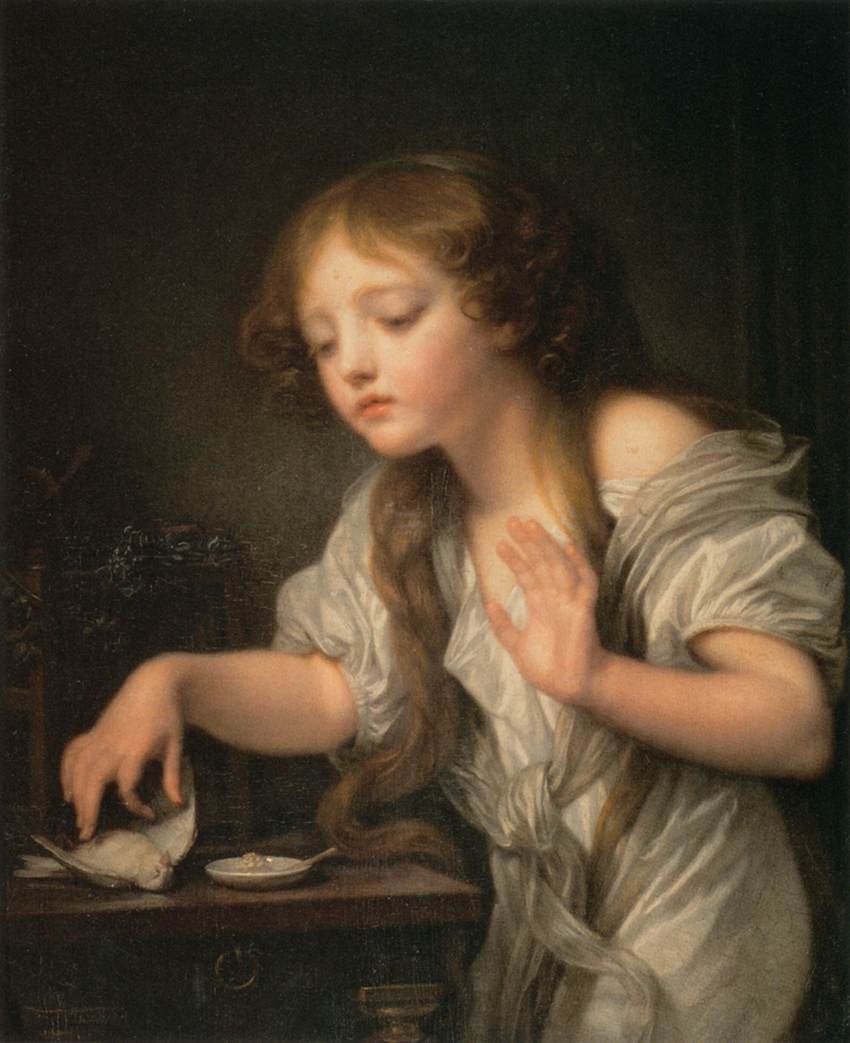
What captures the critic’s attention most is Greuze’s painting of a young girl who bemoans the loss of her bird. Using Greuze’s symbolic images to create his own story about a girl who regrets the loss of her virginity, Diderot waxes ecstatic over this painting:
Lovely elegy! Beautiful poem! The pretty idyll that Gessner would make! It’s the vignette of a piece by this poet. Delectable painting, the most pleasant and perhaps the most interesting of the Salon. (381)
Although the critic describes L’Oiseau Morte in great detail, he focuses above all on the emotional appeal of the girl’s youth, beauty and sadness to an implicitly male viewer. A good painting, Diderot seems to suggest, is not one that puts pictures into words, thus conforming to Neoclassical principles, but one that touches viewers so deeply, both visually and emotionally, that they invent their own stories about it. A good painting is a novel, not just a scene, authored primarily by the viewers, not just the painter. It stirs the senses and sensibilities, refines the taste, stimulates creativity and elevates the mind. For these reasons, Diderot suggests, appreciating such beautiful art is not the consumption of visual images for pleasure but, to return to my initial characterization of his aesthetic stance, a form of passionate lucidity.
In saying that taste requires lucidity—which entails seeing a beautiful object clearly and from multiple perspectives as well as explaining one’s judgments compellingly to others—we see that one’s faculties and sensibilities have a lot to do with what we call art and our appreciation of it. The transmission of taste, Diderot indicates, is in part cognitive and in part rhetorical: it’s an emotive, not just aesthetic, sensitivity to beauty that can be expressed to a broader community in a way that can be appreciated by others. Not everyone has such a sensibility, and certainly not everyone has such powers of persuasion. But Diderot certainly did and this is part of why he succeeded in being a trend-setter of the artistic standards of his times. His Salons contributed to the rise of a style that, in its emphasis upon simplicity and moral elevation, revived classical standards while also foreshadowing, in its emphasis upon pathos and passion, the work of the Romantics. It would therefore not be an exaggeration to find in Diderot’s Salons the aesthetic blueprints for both Neoclassicism and Romanticism.
https://rowman.com/ISBN/9780739116753/Romanticism-and-Postromanticism
(sursa foto: journal18.org)


