 Claudia Moscovici
In 1837, Victor Hugo wrote to his friend, Juliette Drouet, “A letter is a kiss sent by mail.” Hugo’s brief phrase captures the essence of the rich tradition of epistolary novels in France. Although referring to real letters as opposed to novels, Hugo’s definition underscores the expressive powers of letters to convey through language a sense of intimacy and immediacy of communication that rivals, and sometimes even exceeds, direct contact. For Hugo, as for the epistolary novelists, passionate love is the privileged subject of letters. Only because of the special status of this subject can Hugo compare a letter to a kiss sent by mail.
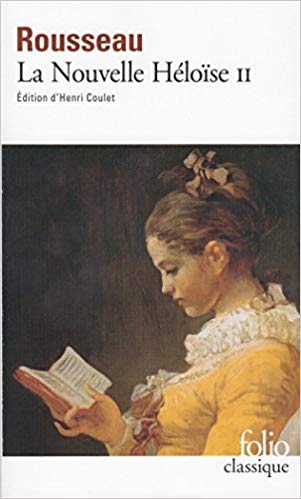
Using Jean-Jacques Rousseau’s La Nouvelle Héloïse as a significant example of the tradition of French epistolary novels, I wish to examine how this novel is able to represent Romantic passion in a modern way that comes close to how we understand it today: namely, as a complex, compelling, at once emotional, cognitive and ethical force that is at the very center of our lives. Rousseau’s representation of passion is all the more important because it contributes to displacing reductive or dismissive views of the concept. La Nouvelle Héloïse illustrates that passion cannot be regarded simply as the opposite of either morality or reason; which is to say, as a blind and uncontrollable drive that threatens human societies. Because of the close connection established by Rousseau between passion and morality, in Enlightenment and Pathology, Anne Vila aptly classifies Rousseau’s novels as contributing to the Enlightenment morale sensitive, placing them alongside the writings of the naturalist Tissot. She maintains that both authors attempted to preserve natural virtue by using the healthy aspects of sensibility to perform a moral cleansing of the sources of social corruption and of the uncontrollable elements of emotion itself.
Perhaps due in part to the complexities of its literary form, however, Rousseau’s vision of love exceeds the boundaries of its own moralism. While the author describes passion as sometimes uncontrollable, forceful and emotive, he also relates it to human values, cognition, sense of purpose and processes of reasoning. As Martha Nussbaum puts it in Upheavals of Thought, “Emotions are not just the fuel that powers the psychological mechanism of a reasoning creature, they are parts, highly complex and messy parts, of this creature’s reasoning itself. Thus a theoretical account of emotions is not only that: it has large consequences for the theory of practical reason, for normative ethics and for the relationship between ethics and aesthetics” (3). Rousseau’s early Romantic vision of passion does, indeed, provide us with such a complex and messy ethical model of human emotion, one which is inextricably tied to its literary form.
The Epistolary Novel
La Nouvelle Héloïse does not convey, however, a universal philosophy of love. Rather, this novel captures in a literary manner a historical moment whose effects we continue to experience today. I wish to explore here Rousseau’s depiction of passion and its connections to other human faculties and concepts—such as virtue, honor, reason and jealousy—by pursuing some of the ethical, aesthetic and social questions raised by this novel. Why, for instance, does the author choose, as did so many others before him, the epistolary form as the optimal literary medium for the expression of passion? How do letters come to acquire the privileged status assumed by Hugo as conduits of human sentiment? Similarly, in the end, what model of the family does Rousseau endorse in depicting the effects of passionate love?
Nancy Armstrong shows in Desire and Domestic Fiction that the tradition of the epistolary novel in England, Germany and France contributed to the formation of a modern understanding of desire and love that could fit the social and emotional needs of the new nuclear family. While certainly participating in this cultural process, Rousseau’s novel at the same time poses an obstacle for it. As the abundant criticism on the subject reveals, the conclusion of La Nouvelle Héloïse is puzzling: not so much in its tragic resolution, but rather in its implicit critique of all of the models of love and of the family it represents. In other words, the complex logic of passion both creates and undoes Rousseau’s proposed system of moral values.
To begin examining this problem, let me first briefly situate Rousseau’s novel with respect to the tradition of epistolary literature and expressive theories of art. While novels contained letters before the eighteenth-century, it was during this period that the epistolary novel became most popular. One of the most famous seventeenth-century novels of letters, Guilleragues’ Lettres portugaises, already foreshadowed the tension among uncontrollable passion, individual moral limitations and social constraints as the major theme of the epistolary genre. During the eighteenth-century, this type of novel became so popular in France that it branched out into several sub-genres. We could characterize, for example, Montesquieu’s Lettres persanes (1721) and Madame de Graffigny’s Lettres d’une péruvienne (1747) as travel narratives or as novels of ideas; while Crébillon’s Lettres de la marquise de… au comte de R…(1742) and Laclos’ Les Liaisons Dangereuses (1782) fit into the category of libertine novels. This tradition of literature gained prevalence between the years 1750 and 1820, and, as J. Herman indicates in Le mensonge romanesque, reached the peak of its popularity in 1780, when 450 letter-novels were published in France, a third of which were translations of British fiction.
Not surprisingly, the rise in popularity of epistolary fiction more or less coincided with the birth of Romanticism and expressive theories of art. The main principles of Romantic literature seem particularly well-suited to the epistolary form. In The Mirror and the Lamp, M. H. Abrams illustrates that Romantic literature presents art as a special kind of expression of feeling. Taking Wordsworth as his principal example, Abrams finds in the latter’s definition of poetry as “the spontaneous overflow of powerful feelings” a more general characteristic of Romantic literature, even that which, like Rousseau’s novel, predates British Romanticism.
We can see how the epistolary novel would lend itself to the Romantic understanding of emotion. The letter form easily mimics real letters and builds upon the seventeenth-century tradition of letter writing popularized by Mme de Sévigné. The use of the first-person singular in letters conveys the impression of a transparent self pouring out his or her real feelings to a reader prepared for emotional identification. At the same time, as J. Herman points out in his study of the genre, the epistolary novel’s use of several correspondents and of a variety of situations and points of view allows for complexity of expression, creating what Bakhtin has called a “polyphonic” or multiple-voiced text. This genre also permits the cohesion and organization of ideas, themes and tropes, since epistolary novels are often presented by an editor who clarifies what is happening, makes value judgments and provides readers with additional information in prefaces and footnotes.
The Novel’s Plot and Sources
Rousseau wrote La Nouvelle Héloïse at Monmorency. This novel was in part inspired by his love for Sophie d’Houdetot, who was in turn in love with the poet St.-Lambert. Published in 1761, La Nouvelle Héloïse became an instant bestseller. Expressive, poignant and emotive, the novel had special appeal for its readers as many of them thought it was not a work of fiction, but the exchange of real love letters. Once literary expression could be linked to authenticity of feeling, the gap between reality and representation appeared to diminish, if not altogether disappear. The scene is set on the shores of Lake Geneva, but the plot harks back in time to the relationship between Peter Abelard and his pupil and mistress, Heloise.
As in the medieval relationship, the heroine, Julie, the daughter of the Baron d’Etange, falls in love with her middle-class tutor, Saint-Preux. Since Julie’s father hopes to find a suitable aristocratic match for his daughter, he strongly opposes her marriage to the tutor. Upset by the tension in her family, Julie’s mother dies of sorrow. Although Saint-Preux is obliged to leave Julie and travels around the world, the lovers remain closely in touch through their letters. When he returns, Julie is already married to Wolmar, an aristocrat who nonetheless seems to represent Rousseau’s middle-class ideals of masculinity. Frugal, virtuous, practical and rational, the husband complements the wife’s sensitive and emotive femininity. The tutor eventually joins the couple and their family without reigniting his affair with Julie and thus violating their sense of honor. Yet the fragile equilibrium among the three friends breaks once Julie sacrifices her life to save a child from drowning.
Significantly, one of Saint-Preux’s first gestures is to establish both rhetorically and sentimentally the modernity of his relationship to Julie by distinguishing himself from Abelard. As is well known, Peter Abelard (1079-1142), one of the foremost logicians and philosophers of his times. He’s arguably even more famous, however, because of his tumultuous personal life: most notably, the fact that he fell in love, had a child with and secretly married Heloise, the aristocratic girl he tutored. To punish Abelard for dishonoring his niece, Heloise’s uncle hired a group of thugs to attack and castrate the young man. Both Abelard and Heloise subsequently retreated into monasteries. Following their separation, Abelard did not show the same intensity and loyalty of feelings to Heloise that she maintained for him and that Saint-Preux wishes to show his beloved. The difference between medieval and modern romance, Rousseau suggests, lies not so much in the behavior of the woman as in that of the man.
As Saint-Preux writes to Julie just after their first kiss and overt avowals of love, “I’ve always felt sorry for Héloïse; she had a heart made for love; but Abélard never seemed anything but a sad man who deserved his fate, since he knew as little about love as about virtue” (Première partie, Lettre XXIV, Flammarion, 61, my translation). Embittered by his punishment and true to the religious values of his times, Abelard proved incapable of perceiving erotic love as at the same time sublime and transcendental. He ultimately chose the love of God over passion for his beloved. Saint-Preux wishes to do the opposite. He gives voice to the early Romantic conception of human love as (at least in part) transcendental.
For him, Romantic love entails the elevation in esteem of a human being who comes to represent ideal moral and aesthetic qualities: beauty, virtue, goodness. These qualities had been associated with the divine by previous models of love, including the Platonic and the Christian, which, as Martha Nussbaum points out in Upheavals of Thought, had represented love as an ascending ladder from the contingent (or ephemeral, accidental and carnal desire) to the transcendental (or everlasting feelings motivated by universal or religious values). Yet, one may ask, why the need to attribute transcendental value to earthly love? And how is this possible to achieve when speaking of relationships between contingent, vulnerable and imperfect human beings? These questions lie at the center of a novel that represents the tension between the fragility of human life and feelings and the search for absolute meaning—a tension that would become the chief characteristic of Romantic literature, art and philosophy.
https://rowman.com/ISBN/9780739116753/Romanticism-and-Postromanticism


