
 Oxana Golubovschi
Abstract
This study examines English as a Foreign Language (EFL) vocabulary instruction at the intermediate (B1-B2) level through the perspective of multilingual communication and teacher education. Vocabulary development is treated not as the memorization of isolated words but as the formation of lexical competence that supports receptive and productive language use, mediation, intercultural awareness, and interaction with speakers from different linguistic backgrounds. The article synthesizes methodological approaches to vocabulary teaching and proposes a pedagogical model based on the Presentation-Practice-Production (PPP) sequence. The model combines contextualized presentation, structured practice, communicative production, revision, and multilingual strategies such as cross-linguistic comparison, work with cognates and false friends, paraphrasing, reformulation. The analysis also considers vocabulary learning strategies, digital resources, and assessment procedures that can support intermediate learners. Particular attention is given to the preparation of pre-service and in-service teachers, who need to know when learners’ other languages can serve as pedagogical resources and how to maintain English as the principal language of communicative production. The proposed framework offers a compact didactic basis for vocabulary instruction in linguistically diverse classrooms and for teacher-training activities that connect lexical knowledge with multilingual and intercultural communication.
Keywords: teacher training, multilingual communication, intermediate EFL, vocabulary instruction, intercultural pedagogy, didactic strategies.
Introduction
Vocabulary is a central component of foreign-language proficiency because learners cannot participate effectively in listening, speaking, reading, or writing without sufficient lexical knowledge. At the intermediate level, the challenge is no longer limited to recognizing the basic meaning of a word. Learners must also understand how lexical units behave in context, how they combine with other words, what register or cultural connotations they carry, and how they can be retrieved rapidly during communication. For this reason, vocabulary instruction needs to move beyond rote memorization and develop lexical competence through purposeful use, repeated encounters, and communicative practice (Nation, 2001; Schmitt, 2000; Thornbury, 2002).
This challenge becomes more complex in multilingual classrooms. Learners rarely approach English as linguistically blank subjects: they already possess knowledge of one or more languages and use this knowledge when interpreting unfamiliar vocabulary, comparing meanings, constructing associations, and negotiating communication. Contemporary understandings of plurilingual competence therefore view the learner’s linguistic repertoire as a resource that can support meaning-making and mediation rather than only as a source of interference (Council of Europe, 2020). Planned pedagogical translanguaging can make these resources visible while keeping the instructional objective focused on increasingly accurate and independent English production (García & Wei, 2014; Cenoz & Gorter, 2021).
The issue is especially important for teacher education. Pre-service and in-service teachers need a methodological basis for selecting vocabulary, presenting meaning, organizing practice, assessing retention, and responding to cross-linguistic transfer. They also need to distinguish productive use from simple recognition and to create activities in which learners explain, paraphrase, reformulate, compare, and adapt lexical choices for different interlocutors. These abilities connect vocabulary instruction with multilingual communication, sociolinguistic awareness, and intercultural competence.
The purpose of this article is to synthesize theoretical and methodological perspectives on intermediate vocabulary instruction and to organize them into a pedagogical model suitable for B1-B2 EFL teaching. The model integrates presentation, practice, production, revision, assessment, and multilingual awareness. The article addresses three related questions: which principles of vocabulary instruction are most relevant at the intermediate level; how can multilingual communication be incorporated without reducing opportunities for English use; and how can these principles be translated into a coherent framework for teacher preparation and classroom practice.
Literature Review
Lexical competence and vocabulary learning
Lexical competence includes more than knowledge of dictionary definitions. A learner needs information about form, meaning, grammatical behavior, collocation, word family, frequency, register, and appropriate use. The concept of the lexeme is useful because it draws attention to the fact that a lexical item can include inflected forms, polysemy, compounds, phrasal verbs, and idiomatic combinations rather than functioning as an isolated orthographic string (Pavičić Takač, 2008). From a pedagogical perspective, knowing a word therefore involves both receptive recognition and the ability to retrieve and use it in meaningful contexts.
The distinction between receptive and productive vocabulary is particularly important for intermediate learners. Receptive knowledge allows students to identify and interpret lexical items in spoken or written input, including by using context and word-formation clues. Productive knowledge requires learners to select a suitable lexical unit, combine it accurately with other words, and use it according to a communicative intention. Productive control is typically more demanding than recognition, which explains why a learner’s passive vocabulary may be considerably larger than the vocabulary used spontaneously in speaking and writing (Nation, 2001; Schmitt, 2000).
Lexical skill develops gradually through repeated encounters and increasingly autonomous use. Vocabulary learning is strengthened when students notice a new item, understand its meaning and form, retrieve it repeatedly, connect it with existing knowledge, and use it in varied situations. The learning process therefore benefits from a balance between explicit attention and meaningful exposure. Explicit instruction can direct attention to form, meaning, collocation, and use, while reading, listening, and interaction provide opportunities for incidental learning and contextual reinforcement (Krashen, 1996; Hulstijn & Laufer, 2002a).
Vocabulary learning strategies give learners greater control over this process. Schmitt and McCarthy (1997) distinguish strategies for discovering the meaning of new words from strategies used to consolidate words that have already been encountered. These include determination, social, memory, cognitive, and metacognitive strategies. At the intermediate level, strategic competence is important because the volume of vocabulary exceeds what can be taught directly. Learners need to infer meaning, consult dictionaries effectively, record lexical information, organize words semantically, review them systematically, and monitor which words remain difficult.
Memory techniques can support retention when they create meaningful associations rather than mechanical repetition. Flash cards, word families, semantic maps, visual associations, and spaced review can help students link new vocabulary with prior knowledge. However, isolated memorization is insufficient if the learner does not meet and use words in context. Effective instruction therefore combines deliberate learning with communicative tasks and repeated retrieval in listening, speaking, reading, and writing (Nation, 2005; Thornbury, 2002).
Multilingual communication as a dimension of vocabulary instruction
In a multilingual perspective, vocabulary learning is shaped by relationships among the languages available to the learner. Similarities can facilitate learning, while differences can generate transfer problems. Cognates may accelerate recognition, but false friends may create inaccurate assumptions. Words that appear to be equivalent across languages may differ in collocation, register, politeness, frequency, or cultural meaning. Consequently, vocabulary instruction can benefit from short, purposeful comparisons that make these relationships explicit and then return learners to English-language use.
The CEFR Companion Volume places mediation and plurilingual/pluricultural competence within communicative language ability and describes learners as social agents who can draw on different linguistic resources to create meaning (Council of Europe, 2020). Applied to vocabulary instruction, this means that learners can be asked to explain an English term to a peer, reformulate a difficult expression, summarize information for someone with a different linguistic background, or compare how a concept is lexicalized across languages. Such tasks move vocabulary beyond translation and turn lexical knowledge into a tool for communication.
Pedagogical translanguaging offers a related principle. It does not imply uncontrolled switching between languages or abandoning the target language. Rather, it involves deliberate use of more than one language for a specific learning purpose, followed by target-language consolidation (Cenoz & Gorter, 2021). For example, students may first compare equivalents in languages they know, identify differences in connotation, and then produce an English explanation or dialog. A multilingual glossary can include English definitions, collocations, examples, cognate notes, false-friend warnings, and culturally sensitive usage rather than functioning as a simple bilingual list.
This approach also strengthens intercultural communication. Lexical choice often signals social distance, politeness, evaluation, and cultural assumptions. Intermediate learners need opportunities to notice when a literal equivalent sounds too formal, too direct, outdated, or inappropriate in English. Comparing lexical choices across languages can therefore develop sociolinguistic and pragmatic awareness. The aim is not native-like uniformity but flexible communication: learners should be able to select a comprehensible and context-appropriate expression, recognize misunderstanding, and repair it through clarification or paraphrase (Council of Europe, 2020).
For teachers, multilingual awareness requires diagnostic skill. The relevant question is not simply whether the first language should be permitted, but how and when another language contributes to learning. Brief comparison can reduce confusion, especially with abstract concepts or false friends; excessive translation can limit the depth of English processing. Teachers therefore need to set clear purposes: other languages may be used to activate prior knowledge, compare meanings, or mediate a concept, whereas practice and production should progressively require independent English use.
Approaches, strategies, and assessment
A communicative approach to vocabulary instruction treats lexical items as resources for accomplishing tasks rather than as decontextualized content. Meaningful contexts help learners understand not only what a word means but also where and why it is used. Realia, pictures, gestures, short texts, dialogs, examples, and contextual clues can support presentation, especially when the teacher avoids lengthy explanations and provides enough information for learners to infer or verify meaning (Gairns & Redman, 1993; Thornbury, 2002).
Contextualization should be combined with systematic attention to lexical relationships. Synonyms, antonyms, word families, collocations, semantic fields, and associations help learners build networks rather than isolated entries. Mind mapping and word association can activate prior knowledge and reveal relationships among lexical items. Dictionary work is useful when learners are taught to choose an appropriate sense, examine pronunciation, grammatical information, collocations, and examples instead of selecting the first translation offered by a dictionary. Digital dictionaries and corpus-informed resources can make this process faster, but the pedagogical objective remains informed lexical decision-making.
Practice needs to vary in cognitive and communicative demand. Recognition tasks such as matching, selecting, sorting, and multiple choice can confirm initial understanding. Retrieval tasks such as gap filling, sentence completion, cloze work, or definition-to-word matching require stronger recall. Productive tasks such as role-plays, information gaps, problem solving, stories, interviews, and discussions require learners to retrieve vocabulary while managing meaning and interaction. A progression from controlled to freer use allows learners to gain accuracy before they are expected to use new items spontaneously (Harmer, 2007; Nation, 1990).
Games can support this progression when they have a clear lexical objective. Word association, taboo-style description, memory matching, crosswords, and word-formation challenges can increase the number of encounters with target vocabulary and lower the affective pressure of retrieval. Their value depends on the quality of the linguistic processing they generate. A game that requires learners to explain, classify, retrieve, or negotiate meaning is more useful than an activity in which speed or guessing is the only demand.
Assessment is necessary because recognition during a lesson does not guarantee durable lexical knowledge. Vocabulary assessment can include selected-response tasks, matching, contextualized gap filling, sentence writing, short oral production, and delayed review. Different formats measure different dimensions: multiple choice is efficient for broad recognition, whereas sentence construction and speaking reveal productive control. Research on task involvement suggests that retention can be influenced by the amount of attention and processing required by a task, so assessment should not rely on one format alone (Hughes, 1989; Read, 2004; Hulstijn & Laufer, 2002b).
For multilingual communication, assessment should also include the ability to mediate meaning. Learners can be asked to explain an unfamiliar term without translating it directly, reformulate a message for a partner, distinguish a false friend, or adapt a lexical choice to a formal or informal context. These tasks provide evidence that vocabulary has become a communicative resource rather than only a memorized list.
The presentation of vocabulary can combine several techniques because no single procedure is equally effective for all lexical items. Concrete nouns can often be introduced rapidly through realia or images; actions and adjectives may be supported by gesture, mime, or contrasting examples; abstract words may require a short definition, contextualized sentence, or comparison with a familiar concept. Teachers should choose the least complicated explanation that leads to accurate understanding and leaves time for retrieval and use (Gairns & Redman, 1993).
Flash cards remain useful when they contain more than a word-translation pair. The front can present the target item or a picture, while the reverse can include a concise definition, pronunciation, a collocation, and an example sentence. Students can use cards for rapid recognition, matching, peer testing, categorization, and sentence construction. When cards are revisited over several lessons, they provide repeated encounters while allowing the teacher to vary the cognitive demand from recognition to production.
Context-clue activities are particularly valuable for intermediate learners because they teach a transferable reading strategy. Students can identify an unfamiliar word in a passage, examine the preceding and following information, propose a meaning, and then verify the hypothesis in a dictionary. Teachers can draw attention to definition, example, synonym, antonym, and inference clues. The objective is not to guarantee that every guess is correct but to develop controlled inferencing and awareness of the evidence on which a lexical decision is based.
Synonym, antonym, and word-association activities expand lexical networks and reduce dependence on a small number of high-frequency general words. However, synonyms should not be presented as perfectly interchangeable. Learners benefit from short comparisons of collocation, register, and connotation so that they can see why two words may overlap in meaning but differ in use. This is also an appropriate point for multilingual comparison because apparent equivalents across languages often differ in exactly these dimensions.
Translation can be efficient for checking comprehension or dealing with incidental vocabulary, but it should be treated as one technique among many. It is most useful when the teacher wants to confirm a precise meaning quickly, point out a contrast between languages, or prevent a false-friend error. For target vocabulary that learners are expected to use productively, translation should normally be supplemented by English definitions, examples, collocations, and communicative practice (Thornbury, 2002).
Information and communication technologies can increase the frequency and flexibility of vocabulary practice. Electronic dictionaries, online corpora, interactive exercises, mobile flash-card systems, and learning platforms provide rapid access to pronunciation, examples, and review. Yet technology does not replace methodological planning. A digital task should still require noticing, retrieval, comparison, or production. Simply clicking through translations or copying definitions produces limited processing and may create an illusion of mastery.
Multiple-choice and matching tasks are efficient for checking a broad range of vocabulary and are easy to score, but they primarily measure recognition. Their distractors also permit some correct answers through elimination or guessing. Gap-filling and cloze tasks require stronger retrieval because the learner must supply an item, especially when the context restricts the possible answer. Sentence writing and oral tasks provide richer evidence of productive knowledge because learners must select, inflect, and combine vocabulary appropriately. A balanced assessment therefore combines several formats rather than treating one test type as a complete measure of lexical competence (Hughes, 1989; Read, 2004).
Delayed vocabulary assessment is important because performance immediately after presentation may reflect temporary accessibility. A brief follow-up several days later can show which items have entered more stable memory and which need recycling. Teachers can also compare receptive and productive results: a student may recognize the correct option in a test but fail to retrieve the same word in speaking. This difference provides useful information for planning subsequent practice.
Classroom games can increase engagement, but they are pedagogically strongest when success depends on lexical processing. In a memory game, students can match a word with a definition or image; in taboo-style description, they must paraphrase; in word association, they build semantic networks; in scrambled-word or word-formation tasks, they analyse orthographic and morphological structure. Competition can provide motivation, but the teacher should retain time for checking meaning, pronunciation, and appropriate use after the game.
The lexical approach is consistent with this emphasis because it places vocabulary and recurring word combinations at the centre of language use. At intermediate level, teachers can move attention from single words toward chunks, collocations, phrasal verbs, and semi-fixed expressions that make speech more fluent and idiomatic. Teaching the word “make”, for example, is more useful when learners also notice combinations such as “make a decision” or “make progress”. Such patterns reduce the processing burden of spontaneous speech and help learners avoid combinations transferred mechanically from another language.
A competence-based perspective complements the lexical approach. The educational objective is not the accumulation of lexical information for its own sake but the ability to mobilize vocabulary in tasks that resemble real communication. This requires linguistic knowledge together with sociolinguistic, pragmatic, strategic, and intercultural awareness. In practice, vocabulary lessons should therefore connect new items with communicative intentions: describing, comparing, persuading, requesting, explaining, agreeing, disagreeing, and repairing misunderstanding.
The balance between explicit and implicit learning also deserves attention. Explicit learning allows teachers to focus on high-value vocabulary, difficult distinctions, irregular forms, and common collocations. Implicit learning occurs when students meet words repeatedly while reading, listening, and interacting. Intensive classroom work can establish a core of useful vocabulary, while extensive exposure and independent reading enlarge receptive knowledge and create additional encounters with previously taught items (Krashen, 1996; Nation, 2001).
Selection is therefore a methodological issue. Teachers cannot teach every unfamiliar word in a text. Priority should be given to items that are frequent, useful for the communicative objective, relevant to learners’ needs, or important for understanding the material. Less central vocabulary can be glossed or left for inference. This distinction protects classroom time and makes it possible to recycle a smaller number of target words more deeply instead of presenting a large list that receives little subsequent practice.
Recycling should occur across lessons and skills. A word introduced in reading can reappear in a listening task, a short discussion, a writing prompt, and a delayed quiz. Each new encounter can add information about collocation, register, word family, or another meaning. This cumulative view of vocabulary learning is particularly valuable for polysemous words, because learners often know one common sense but fail to recognize or produce other contextually relevant senses.
Teacher feedback during vocabulary work should distinguish different error types. A learner may choose the wrong meaning, use the wrong grammatical form, create an unacceptable collocation, select an inappropriate register, or pronounce a word in a way that interferes with comprehension. Correction is more effective when it identifies the nature of the problem and provides a usable alternative. In multilingual classrooms, feedback can also point out when an error appears to result from literal transfer and invite learners to compare the relevant patterns across languages.
Methodology
The study uses a conceptual and methodological design. It synthesizes established work on vocabulary acquisition, lexical strategies, communicative language teaching, assessment, and multilingual education and reorganizes these principles into a pedagogical model for intermediate EFL instruction. The analysis focuses on the B1-B2 level, where learners already possess a basic English lexicon but need greater lexical depth, fluency, contextual appropriateness, and strategic independence.
The procedure consisted of four stages. First, the literature was examined to identify recurrent principles of effective vocabulary instruction: contextualized presentation, explicit attention to form and meaning, repeated retrieval, varied practice, communicative use, and assessment. Second, the principles were compared with the needs of multilingual communication, particularly mediation, cross-linguistic awareness, and the strategic use of learners’ existing languages (Council of Europe, 2020; Cenoz & Gorter, 2021). Third, the selected principles were organized through the Presentation-Practice-Production (PPP) sequence, with revision treated as an integral part of production and follow-up. Fourth, classroom techniques described in the literature were assigned to the stage in which they can serve the clearest instructional purpose.
The resulting framework is pedagogical rather than a report of a controlled experimental intervention. Therefore, the Results and Discussion section presents the outcome of the theoretical-methodological analysis: the structure of the model, the rationale for its components, and the ways in which multilingual communication can be incorporated into vocabulary instruction. No statistical claims about learning gains are made in the absence of an empirical dataset.
The model was guided by the following objectives:
- to establish a coherent sequence for presenting, practicing, producing, revising, and assessing intermediate vocabulary;
- to combine receptive and productive lexical work with strategy development;
- to integrate multilingual comparison, mediation, and intercultural awareness without reducing sustained English practice;
- to provide teachers with adaptable techniques for different classroom conditions and learner profiles;
- to connect classroom vocabulary work with the preparation of pre-service and in-service teachers for linguistically diverse educational settings.
The model is intended as an adaptable framework rather than a fixed lesson script. Teachers may change the number of target words, the balance between controlled and communicative activities, the use of digital tools, and the degree of multilingual support according to learner age, proficiency, class composition, and instructional time. The central requirement is that each technique should serve a defined lexical and communicative objective.
Results and Discussion
The principal result of the analysis is a three-stage pedagogical model that integrates vocabulary instruction with multilingual communication at the intermediate level. The model uses the familiar PPP logic because it provides a transparent progression from initial encounter to controlled consolidation and freer communicative use. Revision is linked to the production stage because productive performance generates the evidence teachers need for feedback, recycling, and subsequent review.
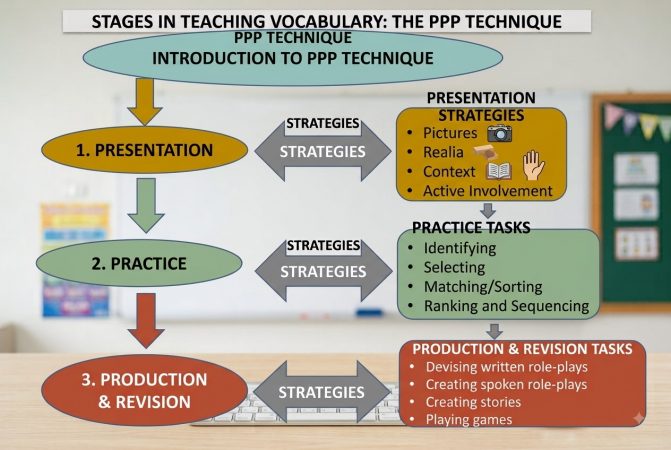
Figure 1. Pedagogical model for improving intermediate-level students’ vocabulary
Presentation. The first stage activates prior knowledge and establishes form-meaning connections. New vocabulary can be introduced through realia, pictures, gestures, short texts, contextual clues, definitions, examples, or carefully selected translation. The teacher should draw attention to pronunciation, grammatical behavior, collocation, and the most relevant meaning for the lesson. At B1-B2, presentation should increasingly encourage learners to infer and verify rather than simply receive definitions. Mind maps, semantic fields, vocabulary cards, and brief dictionary work can help organize new items (Thornbury, 2002; Schmitt & McCarthy, 1997).
The multilingual dimension of Presentation is diagnostic and contrastive. Learners may compare an English item with equivalents or near-equivalents in languages they know, identify cognates and false friends, and notice differences in register or cultural connotation. This phase should be brief and purposeful. Its aim is to activate useful prior knowledge and prevent predictable transfer errors, after which the class returns to English examples and contextualized use. In this way, learners’ repertoires support rather than replace target-language processing (Cenoz & Gorter, 2021).
Practice. The second stage strengthens retrieval and accuracy through tasks such as identifying, selecting, matching, sorting, ranking, sequencing, gap filling, word formation, and contextualized multiple choice. These techniques are most useful when they require learners to make lexical decisions rather than only copy forms. Practice can also include information gaps, pair work, and short problem-solving tasks so that repeated retrieval is connected with meaning. The teacher can vary support by providing word banks, visual prompts, definitions, or partial sentence frames and then gradually remove them.
Multilingual practice extends these tasks through mediation and comparison. Students can match English words to concept descriptions rather than direct translations, build multilingual glossaries with usage notes, explain a false friend to a partner, or compare collocations across languages. An information-gap task may require one learner to paraphrase an English term that another learner does not know. Such activities develop the capacity to negotiate meaning and make lexical choices explicit. Importantly, the final answer or interaction should normally return to English, maintaining the instructional priority of target-language communication (Council of Europe, 2020).
Production and revision. The third stage asks learners to use target vocabulary for a communicative purpose. Role-plays, interviews, stories, discussions, simulations, games, and short presentations create conditions in which vocabulary must be retrieved under time and interaction pressure. The focus shifts from demonstrating knowledge of an item to accomplishing a task with it. Productive tasks also reveal gaps: learners may overuse general words, choose inappropriate collocations, translate literally, or avoid recently learned vocabulary. These observations provide the basis for immediate or delayed revision.
At this stage, multilingual communication can be incorporated through repair, reformulation, and audience adaptation. Learners may explain a concept to a partner from another linguistic background, rephrase a message when a literal equivalent causes misunderstanding, or compare alternative expressions for different levels of formality. They can also reflect briefly on which other-language associations helped or interfered with lexical choice. This turns multilingual awareness into a metacognitive resource and encourages learners to monitor transfer rather than rely on it automatically.
The model also clarifies the role of assessment. Short checks during Presentation and Practice can identify comprehension problems, but evidence of lexical competence should include delayed retrieval and productive use. A combination of recognition and production tasks is preferable because the formats place different demands on learners (Hughes, 1989; Read, 2004). Teachers can assess accuracy of meaning and form, appropriateness of collocation and register, fluency of retrieval, and the ability to clarify or reformulate when communication breaks down.
The discussion suggests several advantages of the framework. First, it creates coherence: techniques are not used as isolated classroom entertainment but are linked to a stage and objective. Second, it accommodates learner differences because support can be increased or reduced without changing the overall sequence. Third, it integrates multilingual communication into ordinary vocabulary work rather than treating it as an additional topic. Finally, it is suitable for teacher education because it makes pedagogical decisions visible: teachers must explain why a technique is used, what lexical knowledge it targets, and how other languages contribute to or distract from the objective.
The model also has limitations. Because it is derived from theoretical and methodological analysis, its effectiveness should be evaluated through classroom implementation with clearly defined learner groups, target vocabulary, and pre-/post-instruction measures. Future empirical work could compare versions of the model with and without planned multilingual mediation, examine delayed retention, and investigate how the usefulness of cross-linguistic comparison varies according to learners’ language combinations and proficiency.
The decision to organize the framework as a model also reflects the need for coherence and adaptability. A teaching model gives instructors a stable sequence for lesson planning while leaving room to adjust materials, grouping, technological support, and multilingual scaffolding. It can therefore accommodate different learner profiles without reducing teaching to a fixed recipe. For teacher trainees, the model makes the relationship among objectives, activities, and assessment more explicit and supports reflective evaluation of why a particular technique is selected.
The framework also encourages a gradual transfer of responsibility from teacher to learner. Presentation provides structured support, Practice distributes responsibility through guided retrieval and interaction, and Production requires greater independence. Revision then makes learners aware of gaps and strategies for improvement. This progression is particularly appropriate for vocabulary because long-term development depends on students continuing to notice, record, review, and test lexical items outside the immediate lesson.
Another important outcome of the analysis is the need to distinguish vocabulary breadth from vocabulary depth. Breadth refers to the number of lexical items a learner can recognize or use, whereas depth concerns how well each item is known. At the intermediate level, progress increasingly depends on depth: learners need collocations, multiple meanings, grammatical patterns, word families, register, and pragmatic restrictions. The proposed model addresses this by allowing the same item to reappear across stages with different demands. Presentation may establish a core meaning; Practice can add collocation or word formation; Production can reveal whether the learner can choose the item appropriately in a communicative context.
The model also supports a distinction between knowledge and automaticity. Students may be able to explain a word when given time but still fail to retrieve it during spontaneous speech. Controlled retrieval tasks reduce this gap by requiring repeated access before freer production. Timed brainstorming, rapid matching, short oral prompts, and repeated role-play can increase retrieval speed, while revision after production helps stabilize forms that remained slow or inaccurate. In this sense, fluency is treated not as a separate skill but as one outcome of repeated lexical access.
Multilingual communication adds a second dimension to lexical depth because learners must understand not only what a word means in English but also how that meaning relates to the categories available in other languages. A direct equivalent may be broader, narrower, more formal, or culturally restricted. When students compare these relations explicitly, they are better positioned to recognize transfer and to choose paraphrase when exact equivalence is unavailable. This is especially useful for abstract vocabulary, evaluative language, politeness formulas, and idiomatic expressions, where literal translation is likely to be misleading (Council of Europe, 2020; Cenoz & Gorter, 2021).
The framework therefore treats errors as evidence for further instruction. If students repeatedly confuse near-synonyms, overgeneralize a cognate, or produce a translated collocation, the teacher can return the item to Practice with a more focused contrast. If learners understand a word receptively but avoid it in speaking, the next cycle can increase productive retrieval. The PPP sequence should not be interpreted as a one-way path completed in a single lesson; vocabulary learning is cyclical, and items may return to presentation, practice, and production as new meanings and uses are added.
From a teacher-education perspective, this cyclical interpretation is valuable because it encourages planning around evidence of learning rather than around textbook sequence alone. Trainees can identify where a word currently sits on the continuum from unfamiliar to recognized, controlled, and productive, and then select the next task accordingly. They can also evaluate whether a multilingual comparison is necessary for a particular difficulty or whether additional English contextualization would be more productive. These decisions form part of pedagogical content knowledge for vocabulary instruction.
The role of learner autonomy is another result of the synthesis. Intermediate learners need procedures for continuing vocabulary development independently because the lexical demands of authentic reading, media, study, and professional communication exceed classroom coverage. The model therefore includes strategy use and self-monitoring at every stage: learners infer and verify during Presentation, record and retrieve during Practice, test themselves during Production, and identify gaps during Revision. Teacher support can gradually shift from directing these actions to helping students select strategies for themselves.
Finally, the model links multilingual communication with intercultural sensitivity. Vocabulary is not culturally neutral: forms of address, evaluative adjectives, terms for social roles, expressions of politeness, and idioms may encode assumptions that do not transfer directly across communities. Teachers can use short comparison tasks to make such differences discussable without reducing the lesson to cultural generalization. The aim is to help learners notice that successful communication may require adaptation to interlocutor, setting, and relationship as well as lexical accuracy.
Applications
The model can be implemented through a compact repertoire of activities rather than a long sequence of separate exercises. For presentation, teachers may use pictures, real objects, short contexts, mime, definitions, or examples. A useful intermediate-level vocabulary card can contain the target item, pronunciation, part of speech, a concise English definition, one or two collocations, an example sentence, and, where pedagogically relevant, a note on a cognate, false friend, or cultural difference. This format provides richer lexical information than a translation-only card.
For structured practice, matching and sorting can be used to connect words with definitions, collocations, semantic fields, or register. Gap-filling and cloze tasks are useful when the surrounding context provides meaningful constraints. Word-formation tasks help learners connect members of a word family, while synonym and antonym work develops lexical flexibility. Instead of giving many similar exercises, the teacher can select a small number that move from recognition to retrieval and then to productive use.
Communicative practice can be created with information gaps, role-plays, interviews, problem-solving tasks, and short stories. A multilingual information gap, for example, may ask students to explain an English concept without using a direct translation, while their partner selects the appropriate word from several alternatives. In a false-friend task, groups compare potentially misleading equivalents and create short English dialogs that demonstrate correct usage. In a mediation task, a learner reads or hears information and reformulates the key meaning in clear English for a partner who has not seen the original. These tasks connect vocabulary with the practical demands of multilingual communication.
Digital tools can support independent work through electronic dictionaries, vocabulary applications, online flash cards, and teacher-created interactive tasks. Their value depends on the quality of the learning action. Students should be encouraged to examine examples, collocations, pronunciation, and usage rather than only obtain a translation. Digital review is particularly useful for spaced repetition and self-monitoring, while classroom time can be reserved for interaction, clarification, and productive use.
Vocabulary games remain useful when their learning purpose is explicit. Memory matching can reinforce form-meaning connections; taboo-style description encourages paraphrasing; word association strengthens semantic networks; crosswords and scrambled-word activities provide retrieval practice; and improvisation games create rapid productive use. In multilingual groups, games can include an additional reflection question asking whether another language helped learners retrieve the word or created interference. This small step transforms entertainment into strategic awareness.
Assessment should be integrated with instruction. A short recognition quiz can be followed by sentence completion, an oral explanation, or a brief role-play using the same vocabulary. Delayed checks are important because immediate success may reflect short-term memory rather than stable learning. Teachers can also ask learners to keep a vocabulary log in which they record difficult words, collocations, examples, cross-linguistic notes, and evidence of successful use. Such logs make learning strategies visible and support learner autonomy.
For teacher education, the framework can be used as a lesson-planning template. Pre-service and in-service teachers can analyse a vocabulary lesson by asking: What lexical knowledge is being taught? Is the task receptive or productive? What type of retrieval is required? Which multilingual resources are available in the group? Is comparison likely to clarify meaning or produce unnecessary dependence on translation? How will learners return to English production? How will the teacher determine whether the vocabulary has been retained and can be used appropriately? These questions encourage reflective practice and link methodology with classroom evidence.
Teacher trainers can also use microteaching. Trainees design a short PPP vocabulary sequence, teach it to peers, and then evaluate the balance between explanation and learner activity, the quality of examples, the progression of cognitive demand, and the role of multilingual support. A second version of the lesson can then be revised to include mediation, cross-linguistic comparison, or culturally sensitive lexical choices. This process prepares teachers to make deliberate decisions rather than apply techniques mechanically.
The practical principle underlying all applications is economy. Intermediate learners do not need every possible technique in one lesson. A focused sequence with a limited set of high-value words, several meaningful encounters, a clear communicative task, and planned revision is more coherent than a large collection of disconnected activities. Multilingual elements should be selected with the same discipline: they are useful when they make meaning, transfer, register, or culture more visible and when they lead learners toward more effective English communication.
A sample B1 lesson can illustrate the sequence. In Presentation, the teacher introduces eight to ten target items connected with travel or work through a short dialog and images. Learners identify meanings from context, compare two potentially misleading cognates, and record one useful collocation for each item. In Practice, pairs complete a matching activity, a short gap-fill, and an information gap in which one student must describe a word without naming it. In Production, groups solve a realistic problem using the target vocabulary, such as agreeing on a travel plan or handling a workplace situation. Revision consists of feedback on collocation and register followed by a short-delayed retrieval task in the next lesson.
A second application can focus explicitly on multilingual mediation. Students receive short descriptions of culturally specific practices or everyday concepts. They first discuss whether their languages contain a direct equivalent and identify where meanings only partially overlap. They then prepare a clear English explanation for classmates who do not share the same linguistic background. The teacher evaluates comprehensibility, lexical appropriateness, use of paraphrase, and the ability to repair misunderstandings. This task integrates vocabulary depth, intercultural awareness, and communication strategy within one activity.
Vocabulary notebooks can be redesigned for the same purpose. Instead of four columns containing only word, translation, pronunciation, and example, learners can record part of speech, collocation, word family, a short English definition, an authentic example, and an optional cross-linguistic note. The multilingual note should be selective: a cognate, false friend, non-equivalent concept, or register difference is more informative than routine translation. Periodic notebook review can ask learners to select which entries have become active vocabulary and provide evidence by using them in sentences or speaking tasks.
For heterogeneous classes, the model supports differentiation without creating entirely separate lessons. Learners who need more support can receive pictures, word banks, sentence starters, or bilingual comparison prompts during Practice. More proficient learners can work with collocational restrictions, multiple meanings, idiomatic combinations, or reformulation tasks. All learners can then participate in the same communicative Production task at different levels of lexical complexity. This maintains a common classroom goal while recognizing differences in vocabulary size and strategic competence.
The same logic can inform homework and independent learning. Rather than assigning long vocabulary lists, teachers can ask students to select a small group of useful items from a text, create cards with definitions and collocations, review them at spaced intervals, and then submit a short audio or written task in which the words are used for a communicative purpose. A later self-check can require students to identify which words were retained, which were forgotten, and which strategy they will use for further review. Such tasks connect autonomy with observable learning behaviour.
Selected classroom activity patterns can be organized according to the type of lexical processing they require. In a picture-word task, students first identify or infer a target item from an image, then label it, pronounce it, and use it in a short sentence. At intermediate level, the teacher can increase the demand by asking for a collocation, a synonym with a different register, or a second meaning. A multilingual extension can ask students whether the same image would normally be described with a direct equivalent in their other language or whether the lexical categorization differs.
A context-clue sequence can begin with a short paragraph containing several unfamiliar but inferable items. Students underline the clues, propose meanings, compare hypotheses in pairs, and verify them with a dictionary. They then write a new sentence in which each word is used with the same meaning. This sequence combines receptive inference with productive confirmation. For teacher trainees, the activity also demonstrates why context must be sufficiently informative: a sentence that gives no semantic evidence cannot genuinely train inferencing.
A synonym-and-collocation task can help students avoid the assumption that similar meanings guarantee interchangeable use. Groups receive several near-synonyms and a set of nouns or situations. They match the combinations they consider natural, justify choices, and check examples in a reliable dictionary or corpus resource. The follow-up asks them to create two short dialogs in different registers. If the class is multilingual, learners may add one cross-linguistic observation about an apparent equivalent that behaves differently.
A ranking or sequencing task can combine vocabulary with reasoning. Learners receive a set of items related to travel, health, study, or work and must rank them according to a criterion or sequence the stages of a process. Because agreement is required, the target vocabulary is repeated while students explain and defend choices. The teacher can provide functional phrases for agreement, disagreement, clarification, and reformulation so that lexical practice is embedded in broader communicative competence.
Role-play is particularly useful for Production because it creates a reason to retrieve vocabulary under interaction pressure. Instead of asking students merely to include a fixed list of words, the teacher can define a situation, roles, and a communicative outcome. A customer and service agent, for example, may need to resolve a problem using vocabulary from a unit on services and complaints. The multilingual component can be introduced by adding a communication breakdown that must be repaired through paraphrase rather than translation.
Short writing tasks provide a complementary form of production. Learners can write a message, description, recommendation, or brief story that incorporates a limited number of target items. The teacher can assess whether the words are used accurately and naturally, then ask students to revise one or two sentences after feedback. This revision stage is important because it turns errors into additional lexical processing and encourages attention to collocation and register rather than only to spelling.
Peer teaching can also strengthen vocabulary retention. Each student or pair becomes responsible for a small set of words and prepares a concise explanation, example, and checking question for classmates. The requirement to explain a word encourages deeper processing, while classmates receive multiple explanations rather than a single teacher-centred presentation. In multilingual groups, peer teachers can mention a relevant cognate or false friend, but the explanation and checking question should remain in English.
Finally, a weekly retrieval routine can connect lessons over time. At the start or end of a class, students spend five minutes recalling previously taught words from prompts such as definitions, pictures, collocations, or situations. Some prompts should require spoken production and others written production. Learners mark items they could not retrieve and add them to personal review lists. This simple routine supports spaced practice and provides the teacher with informal evidence about which vocabulary needs further recycling.
The framework can also be applied to reading-based vocabulary instruction. Before reading, the teacher pre-teaches only the items that are essential for comprehension and difficult to infer. During reading, students mark additional unfamiliar words and classify them as guessable, important, or non-essential. After reading, a small set is selected for deeper work with definitions, collocations, and sentence use. In multilingual groups, students can discuss which items were inferred through cognates or shared roots and which produced misleading transfer. This procedure combines text comprehension with strategy awareness and prevents excessive interruption of reading.
Listening tasks can follow a similar pattern. Learners first hear a short passage for general meaning, then focus on a limited set of target expressions in a second listening. They identify pronunciation features, reconstruct phrases, and compare the expressions with written forms. Follow-up pair work requires the vocabulary in a new spoken context. This is useful because learners sometimes know a word visually but fail to recognize it in connected speech; linking auditory form with meaning is therefore an important part of lexical competence.
For speaking lessons, teachers can prepare a lexical support bank rather than a complete script. The bank may contain key nouns, verbs, collocations, and functional expressions related to the task. During planning, learners select the items they expect to need; during performance, they try to use them naturally; during revision, they identify words they wanted but could not retrieve. A multilingual reflection can ask whether they attempted a literal translation and how they repaired it. This produces concrete data for the next cycle of vocabulary work.
For writing, the same vocabulary can be developed through drafting and revision. Students first write with access to their vocabulary notes, then highlight target items and check whether each one fits the intended meaning, grammatical pattern, and register. Peer review can focus on one lexical dimension at a time, such as collocation or repetition. A final revision asks students to replace over general words with more precise alternatives where appropriate. This process makes lexical choice visible and demonstrates that vocabulary development includes editing as well as initial production.
Teacher-training courses can use comparative lesson analysis to develop professional judgment. Trainees examine two versions of a vocabulary activity: one based mainly on translation and repetition and another that includes contextualization, retrieval, production, and delayed review. They identify what type of lexical knowledge each version develops and propose a multilingual adaptation. The purpose is not to reject traditional techniques automatically but to evaluate what each technique can and cannot achieve within a larger learning sequence.
In-service development can use classroom evidence in the same way. Teachers collect a small sample of learner errors, vocabulary notebooks, or short speaking transcripts and classify the problems as meaning, form, collocation, register, retrieval, or transfer. They then redesign one stage of a lesson to address the pattern. This makes professional learning closely connected with actual learner needs and supports the reflective component of the pedagogical model.
Conclusions
Intermediate vocabulary instruction is most effective as a structured process that connects lexical knowledge with communication. Learners need repeated opportunities to notice, organize, retrieve, and use words in context, and they need strategies that allow them to continue vocabulary development beyond direct classroom instruction. The PPP-based model proposed in this article provides a coherent sequence for these purposes by linking presentation with controlled practice, communicative production, revision, and assessment.
The multilingual dimension strengthens the model by recognizing that learners use an existing linguistic repertoire when learning English. Cross-linguistic comparison, attention to cognates and false friends, mediation, paraphrasing, reformulation, and culturally sensitive lexical choices can support lexical depth and communicative flexibility when they are planned carefully. The goal is not to replace English with other languages but to use multilingual knowledge strategically and then consolidate learning through meaningful English production.
For teacher education, this perspective expands the teacher’s role. Teachers need not only a repertoire of vocabulary activities but also the capacity to diagnose transfer, select appropriate degrees of linguistic support, create opportunities for negotiation of meaning, and assess both recognition and productive use. The proposed framework can therefore serve as a basis for lesson planning, microteaching, and reflective analysis in pre-service and in-service education. Further classroom research should test the model empirically and examine its effects on retention, productive vocabulary, mediation, and learner autonomy in different multilingual settings.
Oxana GOLUBOVSCHI, PhD, Associate Professor, “Ion Creangă” State Pedagogical University of Chișinău
Bibliographic References
Cenoz, J., & Gorter, D. (2021). Pedagogical translanguaging. Cambridge University Press. https://doi.org/10.1017/9781009029384
Council of Europe. (2020). Common European Framework of Reference for Languages: Learning, teaching, assessment – Companion volume. Council of Europe Publishing.
Gairns, R., & Redman, S. (1993). Working with words: A guide to teaching and learning vocabulary. Cambridge University Press.
García, O., & Wei, L. (2014). Translanguaging: Language, bilingualism and education. Palgrave Macmillan. https://doi.org/10.1057/9781137385765
Harmer, J. (2007). The practice of English language teaching (4th ed.). Pearson Education.
Hughes, A. (1989). Testing for language teachers. Cambridge University Press.
Hulstijn, J., & Laufer, B. (2002a). Incidental vocabulary acquisition in a second language: The construct of task-induced involvement. Applied Linguistics, 22(1), 1-26.
Hulstijn, J., & Laufer, B. (2002b). Some empirical evidence for the involvement load hypothesis in vocabulary acquisition. Language Learning, 51, 539-558.
Krashen, S. (1996). We acquire vocabulary and spelling by reading: Additional evidence for the input hypothesis. Modern Language Journal, 73, 440-464.
Nation, I. S. P. (1990). Teaching and learning vocabulary. Newbury House.
Nation, I. S. P. (2005). Teaching vocabulary. Asian EFL Journal, 7(3), 47-54.
Nation, P. (2001). Learning vocabulary in another language. Cambridge University Press.
Pavičić Takač, V. (2008). Vocabulary learning strategies and foreign language acquisition. Multilingual Matters.
Read, J. (2004). Research in teaching vocabulary. Annual Review of Applied Linguistics, 24, 146-161.
Schmitt, N. (2000). Vocabulary in language teaching. Cambridge University Press.
Schmitt, N., & McCarthy, M. (Eds.). (1997). Vocabulary: Description, acquisition and pedagogy. Cambridge University Press.
Thornbury, S. (2002). How to teach vocabulary. Longman.


