 Claudia Moscovici
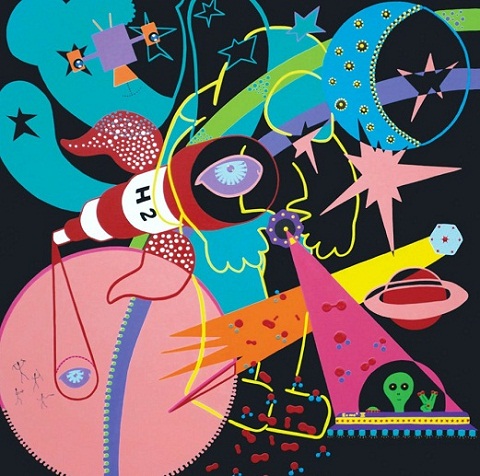
Toyism
In modern art, there are a number of movements that place playfulness and fantasy at their center. Surrealism comes to mind, and also Dada and Pop Art. Toyism is the latest movement in this tradition: it subverts the canon to put the fun back in art. What’s interesting about this game-like movement is the fact that it’s rule-bound. In this respect, it goes against the postmodern assumption that anything goes in art. Since the 1960’s, we’ve been trained by the experts to think of visual art as a realm with consecration (since some artists become better known than others), but no formal rules or boundaries.
Dejo, a Dutch artist and musician, introduced Toyism to the public in the early 1990s. A group has formed, according to the rules, with a membership that usually oscillates between 13 and 20 members, but cannot exceed 26 members, one for each letter of the Roman alphabet. The artists, including the founder, all work under pseudonyms to allow for greater creativity and freedom.
Toyist works are figurative and narrative: they represent recognizable objects and every picture or sculpture tells a story. They tend to use bright and distinct colors, rather than mixtures, for greater contrast and visibility. For this reason, Toyist art is very eye-catching. Although a lot of it looks playful and fun – think of Miro’s Surrealist doodles – the Toyist artists often deal with serious themes, and tend to be more quirky and introspective than other postmodern artists.
The Toyists work in many media and genres, including painting, silkscreen, giclee, print, jewelry and sculpture. If this kind of art fits your personal style or vision, take a look at Toyism.com.
Google Art Project
One month ago Google launched the groundbreaking Google Art Project. This is an online, high-resolution compilation of some of the greatest works of art, featured in famous museums around the world, like the Metropolitan Museum of Art, the Museum of Modern Art and (my personal favorite) the Frick Collection in New York City, as well as the Uffizi in Florence; the Palace of Versailles in Paris and the Tate Gallery in London. Seventeen museums and galleries are currently participating in this revolutionary venture.
Elizabeth Merritt, the Director of the Center for the Future of Museums, has described the project as an “interesting experiment.” Other leaders in the world of art greeted the venture with more optimism. Julian Raby, the Director of the Freer Gallery of Art, stated that this project would increase viewers’ interest in visiting the actual museums. Brian Kennedy shared this view, though he pointed out that even virtual gallery tours offering excellent resolution and panoramic perspectives are not a substitute for seeing works of art in person.
He’s right. Still, in my opinion, the Google Art Project represents the wave of the future – if not the present – and not just for museums, but also for art galleries. Galleries have taken a terrible hit during the past few years. Many were forced to go out of business. During tough economic times, art is seen as a luxury. The Google Art Project generates interest in great works of art once again. And with interest comes visits to the museum and galleries, which in turn, increases the number of art collectors and buyers.
Incidentally, I also love the idea that Google, which now owns YouTube, combines the virtual museum tours with YouTube videos related to selected artists or works of art. By combining beautiful art and music, sometimes even local scenes, and by being so widely accessible to hundreds of millions of YouTube viewers, Google is making art accessible and inviting not only to art lovers but also to those who have only a remote interest in art.
The world of art has reached a pivotal turning point due to this, and similar, technological advances. Those galleries who will adapt to these new ways of reaching viewers to inform and attract the general public will be much more likely to survive than those who will not. I can’t see virtual reality becoming a substitute for actual reality in any domain: be it art, sex or entertainment. But I do see virtual reality as the most effective – and now, indispensable – way to spread information about the reality that will count most in the twenty-first century. You can learn more about this project by visiting the Google Art Project yourself.


