 Claudia Moscovici
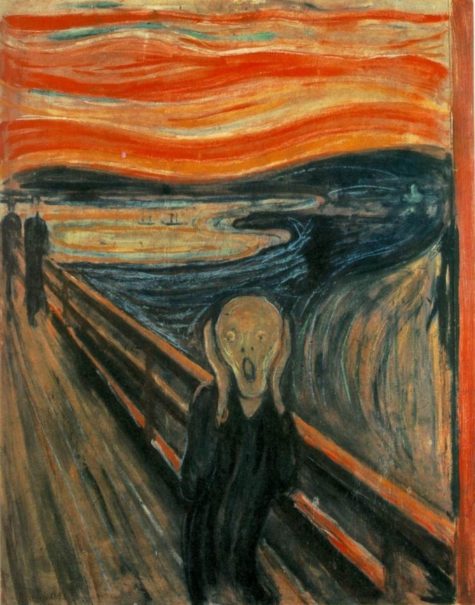
The best-known artist considered to be the forefather of the Expressionist movement is the Norwegian painter, Edvard Munch (1863-1944). Rather than focus, like the Impressionists did, on the optical experiments with play of light in natural settings, Munch turned within, to express through art our most raw human emotions: love, jealousy, hatred, anxiety, fear of death. Munch rendered explicit the goal of his art, stating: “We want more than a mere photograph of nature. We do not want to paint pretty pictures to be hung on drawing-room walls. We want to create, or at least lay the foundations of, an art that gives something to humanity. An art that arrests and engages. An art created of one’s innermost heart” (Edvard Munch, http://www.edvard-munch.com/backg/index.htm).
His most famous work, “The Scream”, exists in several forms: two pastels (1893 and 1895), two oil paintings (1893 and 1910) and several lithographs. In fact, “The Scream” remains one of the most well known paintings in the history of art, selling for $119,922,500 in 2012. “The Scream” series began as an introspective expression of agony, or as Munch put it, “the study of the soul, that is to say the study of my own self”, but soon became a general symbol of humanity’s angst in the modern era. The bright colors reflect feelings of madness and hysteria, while the skeletal form on the bridge confronts our mortality, sketching the boundary between life and death.
Expressionism as an art and literary movement, however, crystallized a decade or so later, in Germany, at the beginning of the 20th century. Expressionist painters, poets and writers placed primary emphasis on the expression of emotion, images and impressions that haunt human beings: in dreams, visions, and in life in general. Not shying away from the underside of human emotion, Expressionist artists conveyed anger, hatred, fear, jealousy, often mixing sex and violence. As the psychologist Carl G. Jung observed, “One does not become enlightened by imaging figures of light, but by making the darkness conscious”.


