 Claudia Moscovici
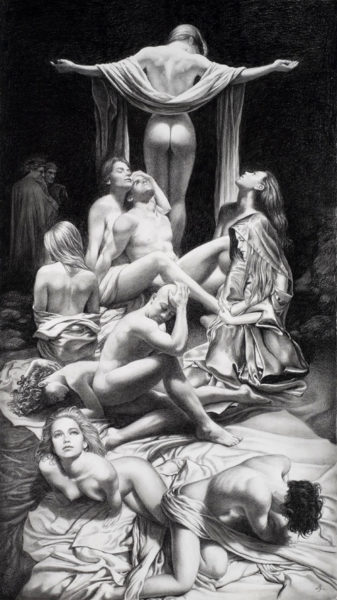
In his new charcoal drawing, Dante’s Dream, the postromantic painter Edson Campos continues his Great Masters series, which has included pastiches of paintings by Vermeer, David and Delacroix: only this time, of course, the artist branches into the literary rather than artistic tradition. (Although there is another painting called Dante’s Dream, painted in 1871 by the pre-Raphaelite artist Dante Gabriel Rossetti). Campos’s drawing seems to combine elements of Dante‘s autobiography with allusions to his literary masterpiece, The Divine Comedy. The perfect, statuesque young woman in the center could very easily be a representation of Beatrice, Dante’s real-life true love–the idealized woman admired from afar–that set the example for the tradition of courtly love in both life and literature.
In fact, when Beatrice died, Dante sought refuge in writing, where his lost love plays a central role in the La Vita Nuova, which describes his youthful romance. In Edson Campos’s rendition, the young woman is facing away from the viewers, with extended arms shrouded by a shall and hands pointing upward, as if she–like her corporal perfection–is no longer of this world.
Yet as she’s oriented towards the other life, she steals a glance at the worldly group behind her, who seem to be characters from The Divine Comedy. Beatrice plays a central role in this work too, as she guides the narrator’s journey through Hell (Inferno), Purgatory (Purgatorio) and Paradise (Paradiso). With subtlety and an incredible power of cohesion, Dante’s Dream combines elements of all three parts. Through the human figures represented in this drawing, Edson Campos manages to capture the different attitudes–despair, longing and redemption–that we find in Dante’s masterpiece.


