 Claudia Moscovici
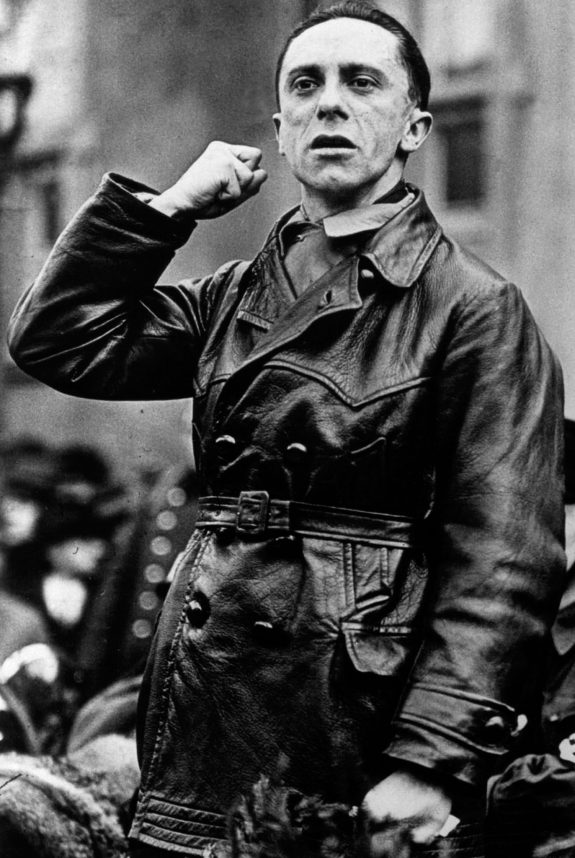
The freedom of expression is a double-edged sword. Without it, no other freedom is possible. Yet this freedom can also lead to the consolidation of totalitarian regimes when groups defined by hatred and discrimination use it to further their goals. This is exactly what happed with the rise of the Nazis regimes. The freedom of speech was turned into propaganda: manipulating public opinion through false or exaggerated statements in support of Nazi ideology.
An inherently manipulative and power-hungry man, Adolf Hitler realized from the start the value of propaganda. His first book, Mein Kampf (1926), includes three chapters on the importance of propaganda in swaying public opinion. Hitler states, quite explicitly: “Propaganda must always address itself to the broad masses of the people… The art of propaganda consists precisely in being able to awaken the imagination of the public through an appeal to their feelings…” He continues to argue that these feelings can, and should be, biased as opposed to describing, as much as possible, the truth: “Propaganda must not investigate the truth objectively and, in so far as it is favorable to the other side, present it to the theoretical rules of justice; yet it must present only that aspect of the truth which is favorable to its own side.” (Mein Kempf)
Once the Nazis rose to power in 1933, Hitler promptly set up a Reich Ministry of Propaganda under the leadership of Joseph Goebbels. The propaganda machine took over all forms of expression: art, film, literature, journalism, theater and the educational system. Everything became imbued with the Nazi ideology and increasingly emphasized hateful messages about the Jews, described in the media as the scapegoats for all of Germany’s problems.
Not content with controlling the content and means of expression in Germany, the Nazi regime also actively suppressed other points of view. As early as 1933, they sent to concentration camps political opponents (starting with those who espoused communist views, but quickly spreading to include those of Jewish heritage, outspoken religious figures and many others who didn’t accept their views).
Propaganda was also essential to depicting the Jews as “subhuman” to the general public. It was used heavy-handedly to justify the oppression and, eventually, deportation of Jews. Newspapers such as “The People’s Observer”, “The Attack” and “The Reich” depicted Jews as parasites depleting the resources of Aryan civilization; weakening and corrupting the gene pool; proponents of Bolshevism; responsible for Germany’s defeat in WWI and for the subsequent economic collapse. Sometimes propaganda became a tool of distorting and even withholding information. The Final Solution plans to exterminate the Jewish people was alluded to in code and not reported to the general public. The Nazis launched one of the first modernized media campaigns to propagate their message.
In his speech “Radio as the Eight Great Power”, Goebbels states: “It would not have been possible for us to take power or to use it in the ways we have without the radio… “ Each time Hitler invaded a foreign country, he launched a highly effective propaganda campaign that turned the facts upside down. For instance the invasion of Poland was described in the media, not only in Germany but also in the international press, as an act of self-defense against a belligerent enemy nation. The same thing, only on a much bigger scale, took place before and during the war with the Soviet Union, starting with Operation Barbarossa on June 22, 1941. Although Germany and the Soviet Union had signed a Nazi-Soviet pact (on August 23, 1939) that made them allies, once Germany launched a war, they described their actions as a defensive move made against Bolshevik Jews who aimed to take over and destroy the world.
The problems of propaganda remain highly relevant, and problematic, today. In any free society, anyone can make whatever claims they wish, with very few limits imposed upon their freedom of expression. Given the way in which the mass media has become accessible to everyone, even the most hateful and extremist groups can propagate their message to the general public.
In the U.S. there are a few limits to the freedom of speech that may limit the power of hate groups. The First Amendment of the U.S. Constitution (adopted on December 15, 1791) posits the freedom of religion, of speech and of the press. In the twentieth-century, however, this freedom of expression became subject to certain limits: 1. Speech (or writing) that presents “a clear and present danger” is not protected by the First Amendment. 2. Similarly, “fighting words,” or speech meant to incite immediate violence is also not protected. 3. Liber and Slander, or making false statements about someone or a group of people, likewise don’t qualify as “free speech”. Finally the First Amendment no longer protects “obscenity”. Although the freedom of expression can never be absolution in democratic societies, excluding certain forms of expression may not be enough to prevent hate groups from using propaganda to rise to power. What is said and printed is as important as what is censored. Offering quality information in the media—well-verified fats, with intelligent commentaries–about events that happen all over the world keeps the public informed, so that we’re better judges of the information we’re presented. Because ignorance is not bliss, but the perfect context for manipulation by dangerous ideologies and groups.


