 Claudia Moscovici
The Holocaust underscored for the Jewish people the necessity—and, many would argue, the historic right–of having their own nation. Deprived of full citizenship rights in many European countries and entirely stripped of human rights once the Nazis came to power, the Jews became ostracized and persecuted throughout Europe. They were branded as outsiders and eventually stomped out like “vermin” by the Nazis, even in countries they had inhabited for centuries. In a prophetic statement issued in 1898, Theodor Herzl, the founder of political Zionism, warned in his groundbreaking book, Der Judenstaat, that the Jews would continue to be persecuted and treated as second class citizens unless they reestablished their own nation:
“The Jewish question persists wherever Jews live in appreciable numbers. We are naturally drawn into those places where we are not persecuted, and our appearance there gives rise to persecution. This is the case, and will inevitably be so, everywhere, even in highly civilized countries—see for instance, France—so long as the Jewish question is not solved on the political level” (Der Judenstaat, cited by C.D. Smith, Israel and the Arab-Israeli Conflict, 2001, 4th ed., p. 53).
The author was referring to the Dreyfus Affair here, a political scandal that erupted in France in 1894, when a Jewish French army captain, Alfred Dreyfus, was falsely accused of being a German spy. Though innocent, Dreyfus was exonerated only in 1906. Even Herzl, attuned as he was to anti-Semitism, could not have foreseen the extent of the human catastrophe of the Holocaust. In fact, Herzl’s book concludes with a hopeful message, which was eventually realized in 1948, but only after the Jews were nearly wiped off the face of the Earth:
“The Jews who wish for a State will have it. We shall live at last as free men on our own soil, and die peacefully in our own homes. The world will be freed by our liberty, enriched by our wealth, magnified by our greatness.” (The Project Gutenberg eBook of The Jewish State, by Theodor Herzl. gutenberg.org. 2 May 2008).
Realizing Herzl’s optimistic message, Israel has become a democratic leader in the world and America’s strongest ally in the Middle East. Though a sliver of a country, it is also a leader in innovation, rivaling that of Silicon Valley. Given its achievements, it is easy to forget that Israel has a population of a little over 9 million people and a large area of desert and semi desert climate (60 % in Southern Negev and Arava), with precipitation only 50 days out of the year. These geographic conditions make agriculture, access to water, and planting vegetation extremely difficult in Israel.
Meeting these challenges and confronting the devastating past of Jewish history, the Jewish National Fund has combined the goals of planting trees and promoting Zionism. Established in 1901 by Theodor Herzl during the Fifth Zionist Congress as “Keren Kayemeth LeIsrael” (KKL-JNF), over the years the Jewish National Fund has repurchased and developed land for the Jewish people everywhere in the country that would become Israel. As Russell Robinson, the CEO of the Jewish National Fund since 1997, points out in his October 22, 2020 Oped in The Times of Israel, a few years after the establishment of the state of Israel, in 1953, the Jewish National Fund-USA separated from the KKL, receiving recognition from the IRS as a nonprofit, 501(c)(3) charitable organization. (https://blogs.timesofisrael.com/were-not-the-wzc-you-should-get-to-know-us/?fbclid=IwAR1raqC808S4iO9wa51-Jw6-uLteU9kDhl9RI-sJL-K3M5eFFq9mgDawxUA)
Yet the Jewish National Fund still collaborates with KKL and retains deep roots in Israel. JNF currently owns about 13 percent of land in the country. Its mission is to grow green space even in areas, like Negev, which are inhospitable to plants and trees. The JNF has facilitated the planting of about 260 million trees (mostly pine and some olive trees), developed 1000 km of land, and created over 1000 parks in Israel. The organization is also committed to innovation, building 200 water reservoirs around Israel that provide 13% of water availability.
The JNF has focused on agricultural innovation, developing solutions for Israel’s water crisis and on the sustainable development of the Negev and the Galilee. It has also been a leader in promoting Jewish education and pro-Jewish views around the world. As Robinson stated in an interview with Fern Sidman in The Jewish Voice, “Jewish National Fund trains and supports pro-Israel college students from across America to promote Israel as a country striving to make the world a better place through the pro-Israel programming.” (https://thejewishvoice.com/2018/05/not-parents-jnf-anymore-russell-robinson-ceo-jewish-national-fund-tells-part-2/) Aside from its important Zionist educational function, the Jewish National Fund spreads the knowledge of transforming an arid climate into a fertile one to the rest of the world.
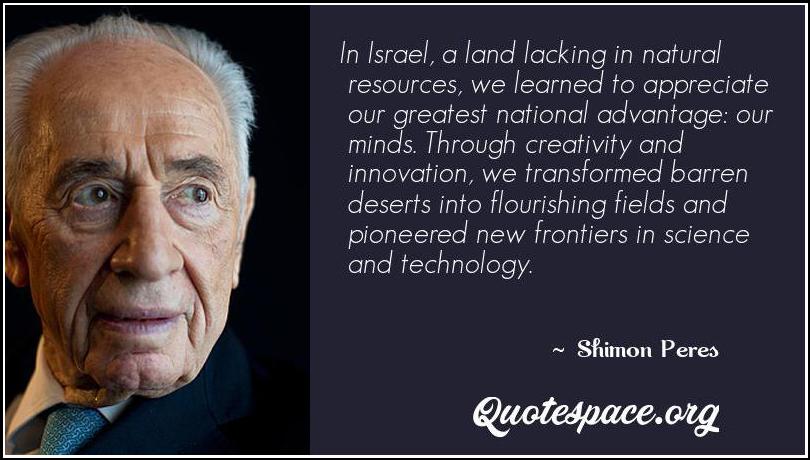
In the conventional account of the progress of societies, the agricultural phase is behind the industrial phase, which in turn is behind the computer age. Yet for Israel, from the beginning, the agricultural phase had to be very innovative and advanced. In fact, it is the country’s early agricultural breakthroughs that transformed an arid, primarily desert, geography into a more fertile land. Nobody encapsulates the challenges faced by the Israelis, and the importance of agricultural innovations to the country, as well as Shimon Peres in his Preface to the book Start-Up Nation: The Story of Israel’s Economic Miracle by Dan Senor and Saul Singer:
“Even with little land and less water, Israel became an agricultural leader. Though many still consider agriculture the epitome of low-tech, they are mistaken; technology was 95 percent of the secret of Israel’s prodigious agricultural productivity. The hostility of the environment did not subside. Israel was attacked seven times in the first sixty-two years of its existence and subjected to comprehensive diplomatic and economic embargoes. No foreign soldiers came to its aid. The only way we could overcome our attackers’ quantitative superiority of weapons was to create an advantage built on courage and technology” (New York: Twelve Publishing, 2009, xi-xii).
The Jewish National Fund has met these challenges for well over a century by promoting the twin goals of agricultural innovation and Zionist education, which not only help Israel thrive, but also make the country a world leader.


