 Claudia Moscovici
The contemporary philosopher and art critic for The Nation, Arthur Danto, has stated that it’s nearly impossible to leave one’s mark upon culture as an art critic. If one looks at how few art critics are remembered, it’s difficult to disagree with this observation. Since the mid-eighteenth century, when art criticism became prevalent, there have been thousands of art critics, but only a handful of them are still known today. Among them, in the French tradition, we can count Diderot, Baudelaire, Gautier, the Goncourt brothers, Zola and Huysmans. But even these cases are difficult to judge from the point of view of art criticism, since all of these writers are known primarily for other accomplishments: Diderot for being the editor of the Encyclopédie and author of novellas, philosophical treatises and plays; Baudelaire for his poetry; Gautier, the Goncourt brothers, Zola and Huysmans for their novels. Would any of these critics be recognized today had they written only about art? In the case of Diderot I certainly think so, and to begin supporting this point, I’d like to consider here the importance of Diderot’s Salons to our contemporary appreciation of art and to the development of Romanticism, particularly as it pertains to what I call his stance of “passionate lucidity.”
Diderot’s Salons have much more than a purely historical value. They did, indeed, allow readers far removed from the Parisian art exhibits to appreciate new works of art. And they do, indeed, still tell us so much—and so entertainingly—about the artistic standards of the eighteenth-century. But they also accomplish more than that. They help us understand better the connection between aesthetics and art criticism—or, otherwise put, between abstract philosophical inquiries about the nature of art and beauty and specific value judgments about particular artists and paintings.
Aesthetics—a word derived from the Greek word aesthesis meaning “sense experience”—concerns itself with the study of art. Aesthetic philosophy seeks to understand the principles that underlie our value judgments: What is beauty? Is it objective in any way? How is aesthetic pleasure related to perception? What is an artist? What is called talent or genius? What makes something be art? Today we believe that such philosophical questions are also historical, and thus cannot be answered only in the abstract. Thus, aesthetic philosophy can benefit from art criticism and art history, which register the responses of a given era and the economic and social forces that helped shape and consecrate art. Art historians and art critics attempt to answer questions such as: What constitutes artistic value for a given period, group or set of artists? What perceptual and aesthetic problems were specific artists working on? Were they successful? By what standards? Who sponsored them and why? What do we think of them today?
Given that the two fields are complimentary and interdependent, it makes sense to combine aesthetics and art history or criticism; yet, surprisingly, in the modern period few critics do. Since the eighteenth-century, there appears to exist an invisible divide between art critics and aesthetic philosophers, such that, for example, in the work of Kant or Hegel the mention of specific artists is almost completely seeped in philosophical abstraction, while, conversely, the writing of art critics such as the Goncourt brothers, despite its exquisite style, learnedness and sensibility, has little philosophical resonance. True to the spirit of the Enlightenment, when the philosophes touched upon every subject that the human mind could grasp, Diderot is one of the few and most engaging modern writers to examine the question of artistic value from a dual perspective, that of philosopher and art critic. His Salons help us think about our own responses to art: particularly to the art of his times, since standards of value and what is considered art have changed beyond recognition since the eighteenth century.
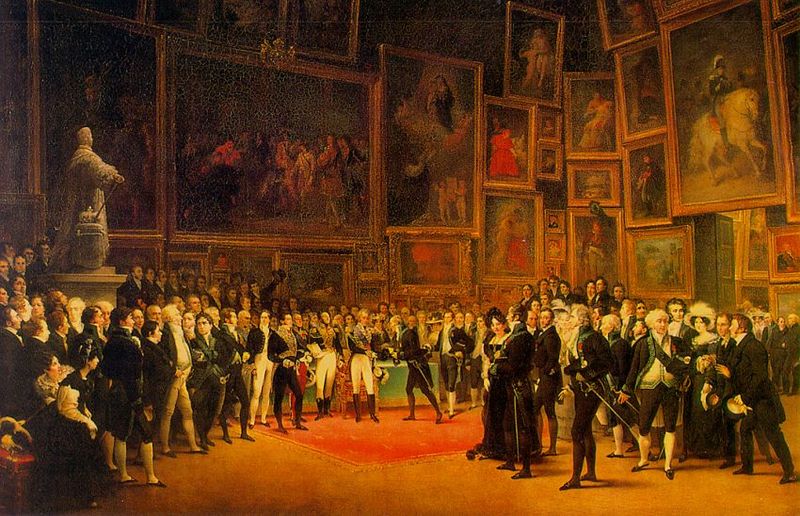
As the title suggests, Diderot’s Salons were a collection of his art criticism of the official Parisian Salon exhibits. These reviews took the form of letters to close friends—particularly to his best friend, Friedrich Grimm, the editor of Correspondance littéraire between 1753 and 1776—and to far-away readers, most of whom could not make it to see the paintings in person. The Salons, in turn, were state-sponsored art shows first held in 1667, under Louis XIV’s reign, at Colbert’s initiative. These art exhibits were initially meant to showcase only the work of artists who were members of the Académie Royale de Peinture et de Sculpture, but became accessible to all artists in 1791, upon the orders of the Revolutionary government. After 1699, the exhibits moved to the prestigious Salon Carré of the Louvre and after 1737, they were organized more frequently, either once or twice a year. Open to the public from the very beginning, the Salons offered a feast for the eyes. Dozens of beautiful paintings were displayed next to one another, covering the walls from eye-level to ceiling. In 1798 the evaluation of artwork and the prizes given at the Salon was placed in the hands of a committee of judges who were members of the Academy and selected by the government. Since the Academy was so important in determining the standards of value of French art for nearly three centuries, it’s also worth saying a few words about it.
Colbert founded the Académie Royale de Peinture et de Sculpture in 1648 in response to pressure from painters who claimed that their occupation was not a trade or a craft, to be controlled only by the guilds. They considered art an intellectual endeavor that required rigorous academic training. Louis XIV developed the Académie using Italian academies, which had flourished during the Renaissance, as his model. Very soon, however, the French Academy set the standards for art in Europe. It adhered to a classical training, where art was taught according to a set of rules established by first drawing copies of Renaissance master drawings, then proceeding to drawing from casts and live models, and finally moving on to oil paintings. Regarding art as an intellectual endeavor that required a broad education, The Academy held lectures and courses on drawing, anatomy, geometry, mathematics and perspective.
During the eighteenth century, the standards of the Salon and the monopoly established by the Academy were disrupted. Popular painters like Chardin, who specialized in still-life, and Greuze, who specialized in portraits, helped shift the hierarchy of subjects and genres, which had privileged allegorical and history paintings. In so far as the Salons were associated with the stringent rules of the Academy, during the nineteenth-century they began to lose prestige. In hindsight, with the popularity of artists such as Manet, the Impressionists and the postimpressionists in mind, we can now look at Salon art—which is sometimes called pejoratively “l’art pompier”—and see it as excessively conservative and narrow in its criteria.
Diderot’s art criticism upheld the value of a kind of Salon art that asserted its uniqueness and independence from the strict standards of Academic painting. We might say that Diderot began a trend of art criticism that celebrated the modernity of art. The influential writings of Diderot, Baudelaire, Gautier, the Goncourts and Zola played an important role for their respective periods in what we can call, retrospectively, the modernization of art by placing increasing value on individuality, passion and creativity rather than on following, even if masterfully, a particular set of academic rules.
Diderot is arguably the most famous of these art critics. He reviewed the Paris Salons of 1759 through 1771, 1779 and 1781. Unlike the livrets distributed at the Salons, which were meant to be looked at during or shortly following the visit to the exhibit, Diderot’s reviews, published as private newsletters, were addressed to a broad, international audience. His readership included members of the royal houses from Russia, Poland, Sweden and other nations—individuals who, for the most part, had not seen the paintings and probably would never have the opportunity to do so. This geographical and temporal distance between readers and paintings compelled Diderot to write his reviews in a personable, engaging, even theatrical style that not only depicted art in vivid detail, but also peppered those descriptions with personal anecdotes and illustrations that made the paintings come to life before the readers’ eyes.
As is the case with most of Diderot’s writings, these reviews don’t fall neatly into any particular genre, straddling several domains. They’re simultaneously aesthetic philosophy; letters to a close friend and to far-away readers; art criticism and entertaining literature. Diderot’s ability to bring art to life for those who, for the most part, didn’t have the chance to see it, parallels his ability to stimulate feelings of love in a relationship (with his mistress, Sophie Volland) that is defined mostly by separation and distance. In both cases, art and love, Diderot cultivates aesthetic passion through a refined narrative imagination heightened by artistic sensibility and tempered by lucidity and knowledge.
https://rowman.com/ISBN/9780739116753/Romanticism-and-Postromanticism
(sursa foto: en.irefeurope.org)


