 Claudia Moscovici
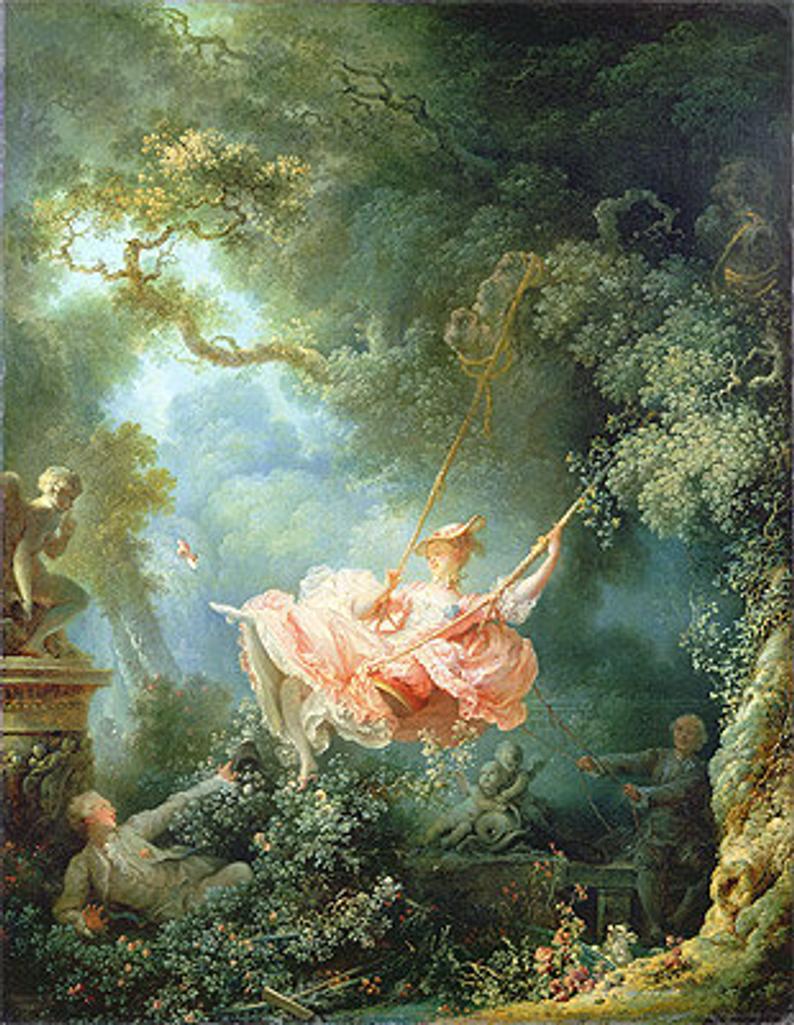
At first glance, in La Nouvelle Héloïse love is sensual. The famous bosquet scene, where Julie, Saint-Preux and Claire share their first kisses, captures the enchantment but also the dangers inherent in erotic desire. Saint-Preux surprises the two best friends and cousins, Julie and Claire, hiding and whispering in a bush:
Upon entering, I saw with surprise your cousin approach me, and, with a pleasantly suppliant air, ask me for a kiss. Without comprehending this mystery, I kissed this charming friend; and, likable and appealing as she is, I never knew that sensations are that which the heart makes them to be. But what do I become a moment after when I felt … my hand trembles… a sweet shiver… your mouth like a rose…Julie’s mouth…placed, pressed upon mine…and my body pressed close to yours. (34, Première Partie, Lettre XVI à Julie)
For a picture of the first kiss of the Romantic couple, this scene is so tantalizingly triangular that we’re tempted to ask what logic requires the presence of Claire. I would argue that this triadic scene allows passionate love to emerge (as it will end) in the context of moral ambiguity. For if the author wishes to situate sensual pleasure in the midst of innocence, what could create a more appropriate situation than two timid school girls whispering to each other, hiding and blushing once they notice the young man they are talking about approach them?
Moreover, what better way to proclaim the involuntary nature of erotic passion, than to initiate it playfully, not by the heroine—who cannot be represented as a libertine or seductress—but by her less eroticized foil? Finally, what better way to describe the difference between harmless desire and tumultuous passion than through the dramatic contrast between Saint-Preux’s responses to the two girls’ kisses? While Claire’s kiss barely registers, Julie’s unleashes the fury of passion, marking its moral ambivalence as both key to virtue and path to destruction: “No, the fire of the sky is not more lively nor more swift than the one that overcame me the minute we kissed.” (34, Première Partie, Lettre XVI à Julie).
Ambivalence also manifests itself in contradictory bodily and psychological reactions. On the one hand, passion gives cohesion to the scattered self, focusing mind and body upon the intensity of feeling and pleasure. This movement towards unity and coherence, however, is countered by a simultaneous and greater movement towards dispersion and self-destruction. Julie takes Saint-Preux’s description of the force of passion as a moral indictment. She too feels overwhelmed by her feelings and sensations:
I had foreseen all too well, the time of happiness passed like lightning; the one of disgrace begins, without anything telling us when it will end. Everything alarms and discourages me; a fatal languor overcomes my soul; without having any reason to cry, involuntary tears escape from my eyes… (Première Partie, Lettre XXV de Julie, 52)
Passion thus assumes the signs that we still commonly associate with it and have made generations of Romantic and Postromantic writers describe it as a force akin to madness: loss of coherence of the sense of identity; loss of control over one’s emotions and actions; depression and loss of vital energy; despair; a sense of detachment from the world and loss of meaning. As the mind gives in to this irrational drive, the body becomes animalized by its own sensuality. When the author focuses upon Saint-Preux’s agitation after the kiss, however, he saves the hero from his drives only by depicting his acute self-awareness:
In the violent transports that move me, I wouldn’t know how to stay in place; I run, I climb with ardor; I throw myself upon rocks; I roam about with big steps and find everywhere in the objects that surround me the same horror that reigns inside of me. (54)
To off-set the effect of the centrifugal movement towards the body and immanence, Saint-Preux evokes centripetal, cohesive images of unity and transcendence. Like Goethe’s Werther, Saint-Preux looks into himself to find a world. The inner world of memories, visual images, and fantasies supplants the dangerous effects of tangible reality. Moving upward on the classical ladder of love, the hero transforms the comic vision of androgyny depicted by the character of Aristophanes in the Symposium into a tragic Romantic union of two complementary beings:
Come, oh my soul! In your friend’s arms let us unite the two halves of our being; come before the sky, guide of our flight and witness to our vows, swear to live and die for one another. ( Premiere Partie, Lettre xxvi à Julie, 53)
Yet the tension between such literary and philosophical elements would remain abstract without the concreteness of social rules and assumptions to give them a specific meaning. Saint-Preux invokes codes of honor to assure Julie that she has no reason to despair. If their act of love had any moral ambiguity, that could be easily corrected by conforming to social and moral conventions and marrying each other. In his advice, Saint-Preux both relies upon and shifts codes of conduct. It had long been the case that marrying the woman one made love to would save her from dishonor. Yet at the same time, the alliance-based model of the family poses an obstacle to such an easy solution. The problem is, of course, that Julie’s family planned to marry her to a man of the same social class and would prohibit her marriage to the middle-class tutor. To overcome this barrier would mean nothing less than succeeding in persuading Julie’s parents that a new model of the nuclear family, based on mutual love and class mobility, should supplant the dominant one they believed in. Perceiving this obstacle as insurmountable, Julie accuses her lover of disingenuous naiveté:
There was a time, my sweet friend, when our letters were light and charming; the sentiment that dictated them flowed with elegant simplicity; it didn’t need either art or color, and its purity was its only decoration… A pure and sacred fire burned in our hearts; abandoned to the ways of the senses, we are now nothing more than vulgar lovers. ( Lettre XXXII, 63-64)
In her accusation, Julie does more than suggest that her lover underestimates the power and value of social prescriptions. She also does more than demand a Romantic understanding of love as an unmediated and undistorted expression of true feelings. Julie proposes a complex model of sentiment, which we can call, following Martha Nussbaum’s Aristotelian description, as the eudaimonic model of love. Such a model regards the beloved as supremely important to one’s happiness and well-being, or what Aristotle called human “flourishing”. This importance is not abstract, but rather related to practical circumstances and possibilities. It depends upon issues such as: does the beloved deserve this valorization; does the love have a future; can the lovers actualize in practical life their union and prove how important they are to one another?
Julie sees love as inextricably tied to three aspects of human experience: 1) her appraisal of the importance of the lovers to one another; 2) her appraisal of their moral distinction (do they act in a sufficiently ethical and dignified way not only toward each other, but also toward others they care about, to be deserving of profound sentiments?), and 3) her appraisal of practical facts and possibilities (can they live out their love and in what manner?). If Julie remains unconvinced by Saint-Preux’s easy moral solution to their problems, it’s because she can’t answer firmly and positively two out of these three questions. Although it’s clear to her that St-Preux is fundamentally important to her happiness and that she is to his, that’s not sufficient to make their love dignified and happy. For instance, Julie is not convinced that their behavior was ethical toward each other both because it risked degrading feelings of friendship to desire and because it does not take into consideration the feelings of other people they care deeply about, most notably Julie’s parents. She’s even less convinced that their love has any practical possibilities, given her father’s desire to marry her to an aristocrat.
What kind of human flourishing is made possible by Romantic passion? Rather than a more strictly Aristotelian one tied to practical possibilities, ethics and external circumstances, Rousseau offers us an internal, psychological model of human flourishing. Romantic passion is nothing less than a conflagration of the senses and emotions ignited by the object of desire as well as by various psychological reactions. Since love is above all a shared emotional state, the author illustrates the importance of jealousy, possession, ambiguity and doubt in fanning the movements of passion. Saint-Preux and Julie constantly provoke and alleviate each other’s jealousy in a partly conscious effort to preserve excitement and desire. St-Preux, for instance, deliberately mentions to Julie his attraction to a beautiful young woman, only to reassure her in a subsequent letter:
How I should love, this pretty Mme Belon, for the pleasure she has given me! Pardon me, divine Julie, I dared enjoy for a moment your tender tears, and it was one of the sweetest moments of my life… What was your delighted lover doing? Was he conversing with Mme Belon? Ah! My Julie, can you believe that? No, no, incomparable girl, he was better occupied! With what charm his heart followed the movements of yours! (Lettre XXXIV, de St Preux, Première partie, 66)
Giving oneself to another, the author suggests, can exist only in the space of intersubjectivity. Two lovers cannot devote themselves to one another in an imaginary world made only for two, as though they lived on a desert island. To give oneself meaningfully to another, one needs to have the sense of choice and freedom. Passion implies the existence of alternatives and the sacrifice of the multiplicity of desire to the strength of one dominant sentiment. When we claim to love we say: among all possible and desirable partners, I give myself to you. But the sacrifice is meaningful, in the sense of not being merely arbitrary, only if there is a qualitative difference of desire and emotion for the beloved as opposed to the impersonal desire for all others. That is to say, love renders the object of affection unique and the nature of desire more intense and rich in feeling—and thus the threat posed by jealousy unreal.
So then, we are led to ask, what is the role of jealousy in passionate love? To create affective movements. The interplay between multiple objects of desire and the choice for the most compelling one. The interplay between freedom and possession. The homage of sacrificing other attractions for one person. The titillation of possibly losing privileged status in the eyes of the one we love. The security of having it, and deservedly, for the moment. In describing the modern self, Rousseau renders jealousy more than just an isolated emotion by tying it to will, freedom of choice, sacrifice, sentiment and moral obligation. When founded, jealousy potentially undoes all of these elements. When unfounded, it makes each dimension of love richer and more poignant.
Julie’s reply, as usual, nuances the picture of the role played by emotions such as jealousy in passion. She responds more cautiously:
It’s not that I don’t know that your heart is made for mine and not another. But we can fool ourselves, mistake a passing fancy for passion, and do as many things by whim as we would have done for love… Swear to me, then, my sweet friend, not by love, a sermon that we only give when it’s superfluous, but by the sacred word of honor; that if respected by you, I will never cease being the confidante of your heart, and that no change will take place of which I’m not first informed. (Première Partie Lettre XXXV, 69)
Julie, however, is only partly satisfied with her lover’s account of jealousy. She believes that his conception of love carries inherent risks. When love is so emotional and sensual, and moreover, when it’s so dependent upon the efforts of one’s imagination to idealize the beloved and render her unique, what distinguishes the manifestations of real passion from a mere coup de foudre; from a strong and impulsive desire? While the durability of passion, the history and friendship of the lovers, the mutual respect based on known rather than merely supposed psychological qualities all render the difference between passion and desire palpable when the two are contemplated calmly and from a distance, they resemble each other in the heat of the moment.
Moreover, Julie observes, with the proper attention and focus, the more superficial form of attraction can develop into love. Knowing that jealousy is based, quite legitimately, on the slippery and often sudden progression from desire to love, Julie asks her lover to warn her of the early symptoms of this transition. She proposes a modern model of faithfulness in love, which she calls “honor,” but which is actually more psychological than social in nature. Fidelity demands the exercise of judgment and caution, the avoidance of potentially dangerous situations which can heat up the senses and create the illusion of true love, and above all, the avoidance of obsessive focus upon other objects of desire that enhances their qualities and renders them special.
First and foremost, therefore, Julie asks Saint-Preux to regard the difference between desire and love ontologically. While the other women he desires are substitutable, she needs to remain a unique and privileged being in his eyes. Second, this distinction must also occur on an epistemological level: for while desire may be involuntary, our consciousness of it is not. Julie thus requires her lover’s mental self-awareness to fortify his moral restraint: as soon as he observes in himself the enhancement and focus upon another woman he desires, she should be the first other person to know about it. In so doing, she claims to appeal to Saint-Preux’s sense of honor, not his love.
What could she mean by this distinction? Given the fact that strong desire and passion can share the same symptoms—if not the same causes—as we all know, love does not guarantee fidelity. Nor does moral obligation, since immediate desires can exceed it, or, to put it more simply, the flesh is weak. What emerges from Julie’s response is thus a more nuanced vision of the ethics of Romantic love. Faithlessness, she implies, has its warning signs. Human beings don’t act upon their desires, like animals, without some psychological preparation: focusing upon desirable persons and their attributes, mentally enhancing their qualities in their imaginations, and perhaps even seeking their company in ambiguous circumstances. Before this chain of symptoms is irreversibly unleashed, Julie demands to be forewarned of the process that transforms attraction into passion so that, together with her lover, they can help one another to remain faithful.
Having transformed the notion of passionate love, Rousseau does the same for that of moral duty. By means of Julie’s reflections on jealousy, he suggests that honor is neither, strictly speaking, the observance of universal moral principles nor that of social prescriptions. Far from opposing morality to convention and principle to desire, Rousseau makes us aware of the intimate links among principle, emotion and desire. Morality begins with the awareness of these connections. For it is above all an epistemological act of self-awareness which makes possible the control of destructive desires, meaning those that hurt oneself, the beloved and society by and large. Only after taking such precautions does Julie agree with Saint-Preux that—when unfounded—jealousy is delightful:
What pleasure I taste in taking useless precautions; in preventing the appearance of a change which I sense to be impossible! What charm to talk of jealousy with such a faithful lover! (70)
Julie is acutely interested in everything Saint-Preux has to say not only about other women, but also about nature, society and culture. She responds thoughtfully to his observations about how French society corrupts the difference between men and women—including his classically Rousseauistic conviction that women need to remain women and men men and that in order to stay properly gendered the sexes should live separately and fulfill different social roles. Jealousy thus serves a point of departure to show not only the potential dangers of being permeable to other human beings, but also its merit in opening us up by our awakening interest in that which is greater than the individual and the couple. By talking about others to Julie, Saint-Preux may excite her jealousy sometimes, but above all he stimulates her interest in broader social phenomena. In this way, the relationship itself remains open to other human beings and to the outside world, encouraging sympathy and civic virtue as well as reinforcing the couple’s love through close communication.
This permeability to one another and sensibility to the world, however, also leads to instability. Perhaps because of its charged and fluid emotional states, passionate love, Rousseau suggests, cannot exist without a sense of doubt: without, that is, the possibility not only of its diminution, but also its dissolution. As worrisome as the tumultuous movements of passion seemed to the lovers, what troubles them much more is a sense of tranquility and complacency. Alarmed by his own calmness, St-Preux declares:
What calm in all my senses! What pure, continuous, universal voluptuousness! The charm of ecstasy was in the soul; it will never leave it; it will last forever. What a difference between the furors of love and such a peaceful situation! (Lettre LV a Julie, 97-98)
Rousseau would like to illustrate that intense passion can be calm and sublimated; that love, once its erotic and emotive elements have been stabilized, grows stronger, more virtuous and deeper. Yet his characters spectacularly contradict such a model of passion. To them, the presence of tranquility only indicates the absence of strong feelings. The doubts awakened by the apparent calmness—raising questions such as, are my feelings as strong, do I still love her, what does that imply about the passionate and loving person I thought I was—only reawaken the movements of emotion. These doubts provoke a sense of despair about the nature of sentiment and identity which arouse Romantic feelings once again with renewed intensity.
The calmness of passionate love is thus only the eye of the tornado; an apparent stillness that’s surrounded by agitation. Passion does not lead to a Stoic or Epicurean understanding of happiness defined negatively, as the tranquility that results from the lack of physical and psychological pain about events outside of one’s control. Rather, passion is a key component in a Romantic understanding of happiness which is more positive than negative. Romantic fulfillment signifies not the absence of pain but the presence of heightened sensations and emotions, especially those provoked by a person who reciprocates and deserves them. Passionate love is shared rather than solipsistic and intense rather than calm.
Rousseau suggests that a genuinely tranquil love—one in which happiness is understood as the lack of pain—requires the absence of strong erotic and emotional attraction. Wolmar’s relationship to Julie illustrates such a relationship. Yet is this calmer model of love and, more generally, of fulfillment more promising than the one offered by passion? Julie and Saint-Preux had frequently discussed the necessary complementarity between men and women. Saint-Preux had often criticized in his letters to Julie the masculinity of French aristocratic women who were as educated as men, surrounded by them in their roles as salonnières, and even behaved like men in devoting their lives to politics and intellectual pursuits. Nonetheless, Julie and Saint-Preux are hardly the complimentary beings implied by their own model of gender. If anything, the two characters are strikingly similar. Both lovers are sensual, sensitive, emotive, observant, obsessive, expressive and analytical. Their actions and rhetoric are at times undifferentiable (although Saint-Preux is at times more heated in his words and reckless in his behavior). By way of contrast to Saint-Preux, Wolmar represents a true masculine foil to Julie and makes her appear more feminine by comparison. What kind of interaction does such gender complementarity yield? In depicting her husband, Julie describes their relationship as follows:
I never saw him either happy or sad, but always content; he never talks to me about himself, rarely about me; he doesn’t seek me, but he’s not upset when I seek him, and leaves me unwillingly. He doesn’t laugh; is serious without making others want to be as well; on the contrary, his serenity seems to invite my play… In a word, he wants me to be happy; he doesn’t say it, but I see it; and wanting the happiness of one’s wife, isn’t that obtaining it? (101)
Being cold and reserved, Wolmar’s love is not impelled by strong emotions or desires, but by a sense of respect, like, and familiarity which Julie calls “attachment.” This attitude is stable and lasting because the reasons behind it are: if Julie was worthy enough of Wolmar’s affection and respect before marriage, provided that she behaves appropriately, she will continue to deserve them. As Anne Vila points out, Julie describes Wolmar as a man who combines a classically Stoic attitude—of apatheia, or absence of feeling in the face of external forces beyond one’s control—with a modern protestant capitalist ethic of frugality and moral health. (see Enlightenment and Pathology, 211). The complementarity between man and woman, in this case, is obvious, but does it lead to love and, perhaps more importantly, to a sense of human flourishing? Julie wishes to persuade Saint-Preux that she considers the former less essential than the latter. Abandoning the idea that passion is necessary for happiness, she writes to her ex-lover:
What misled me for a long time, and what may still mislead you, is the idea that love is necessary for a happy marriage. My friend, that’s a mistake… (Lettre XX de Julie , 274).
Julie claims to share her husband’s understanding of love as a form of mutual respect and friendship. More fundamentally, she accepts his Stoic conception of happiness as the lack of moral and physical pain. She also wishes to emphasize that this model of human relationships, which is calm and self-sufficient, is not by extension also selfish or even amoral. Wolmar may not seek pleasure in life, but he encourages his more fun-loving wife to laugh, enjoy herself and feel happy. Moreover, despite his self-sufficiency, he places value upon her and their children, showing normal fatherly concern when one of them appears to be in danger. Much as he has given us a modern and thus transformed understanding of passionate love by depicting the relationship between the lovers, Rousseau proceeds to present a modernized notion of Stoic virtue in marriage. Does the author set one form of love and happiness above the other? Which one does he ultimately endorse as a role model in his representations of the interaction between men and women and of the nuclear family?
As I suggested in the beginning, it appears that both and neither. For just as passionate love could not lead to moral and social stability, love without passion precludes communication and intimacy. Not fooled by Julie’s consistent praise of her husband, St-Preux writes quite critically of the marriage:
You know Julie, you who know how much this expansive soul loves to share; imagine what she would suffer in this reserved atmosphere, when she would have nothing but this sad communication between those who should have everything in common. (Cinquieme partie, Lettre V à Milord Eduard, p 448)
If intense passion rendered the lovers too similar and volatile to form a stable and lasting union, complementarity renders husband and wife too different to communicate meaningfully. In her last letter, before her death, Julie confirms Saint-Preux’s evaluation of her marriage by declaring that it’s only with him that she seeks eternal union: “The virtue that will separate us on earth will unite us in our eternal resting place.” (Sixth Part, Lettre XII de Julie, 566).
Let’s pause for a moment to reflect about some of the reasons why both models of Romantic love—the passionate and the conjugal—are doomed to failure in Rousseau’s Romantic vision of human emotion. It seems that in the first part of the novel, the author elevated the notion of passionate love to critique the old, alliance model of the family. This model assumed that marriages were made to unite the economic and social interests of two families rather than two beings who loved each other.
The rest of the novel, however, relies upon an ambivalent representation of passion to elevate a model of marriage that strikingly resembles the one previously critiqued. Wolmar marries Julie in part because they’re both aristocrats. Such a marriage clearly serves mutual economic and social interests. Rousseau suggests that to be moral love must be intimately connected to social virtue, as Wolmar’s and Julie’s relationship certainly is and St-Preux’s and Julie’s illicit affair is not, or at least much less obviously. At the same time, the author presents passion as a necessary link between personal and civic virtue. Without passion, in other words, it’s very difficult to be moral.
At the conclusion of the novel, Julie must be sacrificed precisely because the conjugal friendship she has established with her husband leads to a conventional and arid form of virtue rather than to the heart-felt and authentic one endorsed by the novel. What can this paradoxical scenario—where the unpredictability and fire of passionate love overwhelm civic virtue while the tranquility of conjugal friendship render moral behavior a mere convention or abstraction—tell us about Rousseau’s early Romantic conception of passion? Most obviously, it suggests that passion is both necessary and problematic to the individual and to society. Yet even more interesting than the contradictions of Rousseauistic passion is the model of eudaimonia sketched by the novel. For it seems that although La Nouvelle Héloïse sets passion in partial opposition to moral and civic duties, it also depicts it as necessary to human flourishing.
Rousseau’s representation of passion as a foil to conjugal love, in its very tensions and impasses, traces the ethical and emotional boundaries of what we continue to view as the truest and most meaningful form of love today. While passionate love may often violate civic duties and moral principles, it also preserves some of the most fundamental aspects of social ethics. In loving passionately, we step outside our egocentric boundaries to value and even sacrifice our desires for another human being. We also acknowledge the permeability and vulnerability of the self, our dependency upon others, particularly upon those we care about deeply. Finally, individuated love may lead to social sympathy, or to forms of identification with people we do not know well or love, cementing in a real rather than solely abstract manner the concept of civic virtue. Through his Romantic conception of passionate love, Rousseau suggests that although love may sometimes obfuscate the path to civic virtue, such virtue cannot exist without the emotive responses, appreciation of other human beings and modes of identification that only passion excites.
https://rowman.com/ISBN/9780739116753/Romanticism-and-Postromanticism


