 Claudia Moscovici
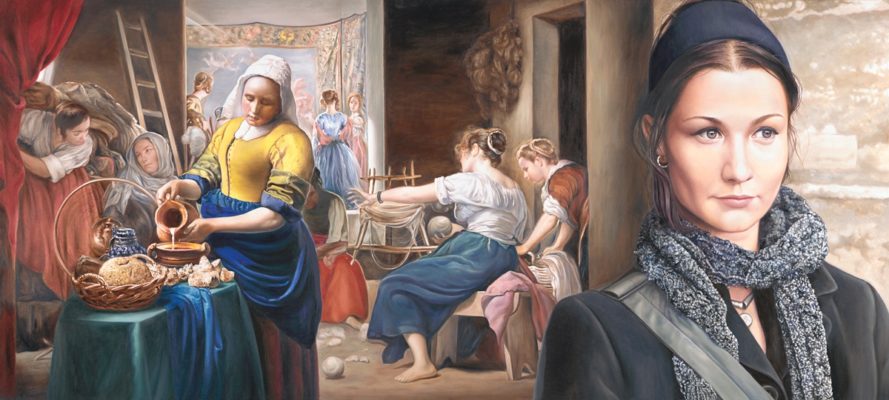
Two celebrated paintings by two of the world’s best-known artists –Vermeer‘s The Milkmaid (around 1657) and Velazquez‘s The Spinners (also 1657) intersect in Edson Campos‘ postromantic pastiche, Eve’s Dream. The Renaissance masterpieces have in common is more than the (approximate) year they were finished and their fame: they share a common fascination with women, particularly working class women. Vermeer’s milkmaid, now housed in the Rijksmuseum in Amsterdam, is considered one of the museum’s main attractions. It features a milkmaid pouring milk into an urn. Her features are calm and concentrated, perhaps on her daily task, perhaps on something else. Viewers are always led to speculate by Vermeer’s profound representations of women.
In the background, blending in seamlessly with the Vermeer painting in the foreground, Campos executes a flawless pastiche of Velazquez’s The Spinners, a painting commissioned by Don Pedro de Arce, the huntsman to King Philip IV. This piece also features servant girls at work, making a tapestry. But the similarities of theme don’t overshadow the differences in portrayal. Influenced by the allegorical approach of Baroque art, Velazquez’s masterpiece is rich with allusions. Some art critics have read in it Ovid‘s Fable of Arachne: the hapless woman who dared challenge the goddess Athena and was turned into a spider as a punishment. Other art critics have identified in it Biblical tales; yet others have seen political and economic messages.
In Eve’s Dream, Edson Campos does justice to both artists and both masterpieces in turn, not only stylistically, in his flawless execution, but also thematically, by keeping true to the ambiguity that characterizes Vermeer’s mysterious portrayals women and Velazquez’s allegorical paintings in general. Going far beyond copying the great masters’ artwork or even creative interpretations and intermixture, Campos adds his postromantic touch in the foreground: a young woman, dressed in a manner that renders her contemporary yet timeless, stands to the side, assuming a posture that is at once contemplative and strong. We don’t know what she’s thinking, yet Campos’s portrait of her, like Vermeer’s representation of the milkmaid or Velazquez’s spinners, provokes viewers to admire and speculate.


