
 Claudia Moscovici
There are dozens of biographies on Picasso, but his psychological profile comes to life with nuance, insight and sensibility in the autobiographical writings of his long-term partner, Françoise Gilot. In Life with Picasso, Gilot illustrates that there’s no contradiction whatsoever between being a great and innovative artist, or an “artistic genius” if you prefer, and being an irredeemably bad and selfish human being, or a psychopath. Although Gilot doesn’t use this clinical label, I believe that this is the psychological profile that emerges from her personal accounts of Picasso’s personality traits and behavior. She also offers unique insight into the artist’s immense creativity and resourcefulness, which doesn’t in any way contradict the image she sketches of his emotional poverty.
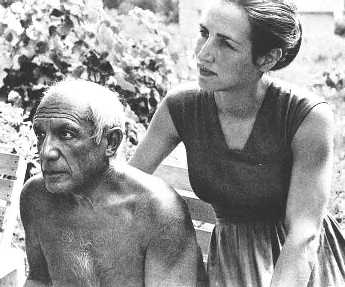
My point here is not to clinically diagnose Picasso, since I’m not qualified to do so. Nevertheless, I’d like to offer from an informed lay perspective a vivid and high profile example of the manifestations of psychopathic traits in someone with extraordinary artistic sensibilities and intellectual acumen. I will rely upon Gilot’s autobiography to dispel the popular misconception that being gifted, cultured and sensitive implies that you can’t be evil. Of course you can. As Hannah Arendt illustrates in her work on the banality of evil, during the Holocaust tens of thousands of intelligent, educated and seemingly “normal” men and women participated in Nazi crimes against humanity. Most of them probably had a conscience and felt some remorse. Some, like Eichmann, did it of their own volition, for their benefit and completely remorselessly. That smaller subset of cruel men and women do not prove, pace Arendt, the banality of evil. They were not ordinary human beings who fell prey to extreme external pressures during extraordinary times. Instead, those shameless individuals prove the banality of psychopathy: namely, of being born with the psychological drive to use and destroy others.
The German people, like the Russian people, have no particular character traits that made them more likely to commit genocide. Unfortunately, psychopathic rulers rose to power in their midst. They encouraged other similarly disordered individuals, as well as the rest of society, to behave ruthlessly towards fellow human beings. Such evil individuals have existed throughout human history, everywhere around the world. They become particularly dangerous and influential in certain social circumstances, such as during war, civil war or in totalitarian societies, when crimes against humanity are condoned and even encouraged.
Analogously, I’m surprised to hear people interviewed on the news about a violent crime remark that “Such horrible things don’t happen in our neighborhood.” Why would they not? Disordered, conscienceless individuals exist in every kind of neighborhood. Until they’re caught and sentenced for their crimes, they’re free to live wherever they want. I also sometimes hear people express great surprise when the vicious murderers turn out to be educated men and women: teachers, professors, doctors, scientists, lawyers, musicians, writers or artists.
Psychologically speaking, there’s no contradiction whatsoever between being naturally gifted in all sorts of ways and being a psychopath. Psychopathy constitutes an emotional deficiency that leads to lack of empathy for others. It’s not an intellectual or artistic deficiency. If anything, as Robert Hare observes in Without Conscience, the opposite logic applies. The more charming, educated, refined and talented a psychopath is, the better his camouflage. Such an individual is more likely to get away with his misdeeds because others will give him the benefit of the doubt or excuse his bad behavior. If you look at evil people throughout history, you’ll see that they cut through every culture, society, level of education, occupation and class. Most psychopaths, as we’ve seen, don’t achieve great success because they tire quickly of their endeavors. But some of them become rich, powerful or famous. A few can even be “artistic geniuses” like Picasso.
In Life with Picasso, Gilot describes Picasso in terms of nearly every key symptom of psychopathy: his total absence of empathy and love; his lack of remorse and facile rationalizations for hurting others; a lust for seduction as a form of exercising power over women; duplicity and manipulation as a way of life; the pattern of idealize, devalue and discard in every romantic relationship he’s had; the underlying desire for control; an unshakable narcissism and the drive to do evil by damaging the lives of the women who became his partners. I’ll now describe Picasso’s pathological behavior in greater detail by relying upon Gilot’s autobiographical account, coupled with relevant psychological explanations of how psychopaths and narcissistic controllers behave.
1. Seduction as a Power Game. Gilot describes how from the very beginning of their relationship, Picasso wanted to be the one in charge. He regarded seduction as a power game, in which he reserved the right to make all the key moves. When she refused to be a passive pawn and didn’t play the predictable role of a “respectable” woman who resists his advances, Picasso was taken aback. She states:
When he dropped the last piece back unto the table he turned abruptly and kissed me, full on the mouth. He looked at me in surprise. “You don’t mind?” I said no—should I? He seemed shocked. “That’s disgusting,” he said. “At least you could have pushed me away. Otherwise I might get the idea that I could do anything I wanted to.” I smiled and told him to go ahead… He looked at me cautiously, then asked: “Are you in love with me?” I said I couldn’t guarantee that, but at least I liked him and felt very much at ease with him and I saw no reason for setting up in advance any limit to our relationship. Again he said “That’s disgusting. How do you expect me to seduce anyone under conditions like that? If you’re not going to resist—well, then it’s out of the question. I’ll have to think it over” (Life with Picasso, 24).
It’s not surprising that Picasso subscribes to traditional gender roles and expects a certain behavior from a “proper” middleclass woman. After all, many men of his generation did as well. More striking is the manner in which he views courtship as a game of conquest with no real adversary. He expects his partner to play into his hand as a passive pawn. Of course, since psychopaths also enjoy a challenge, Gilot’s failure to conform to gender stereotypes also initially intrigued Picasso. In fact, it led him to pursue their relationship further.
2. The Aesthetization of Erotic Experience as a Substitute for Emotional Bonding. Instead of bonding with their partners, psychopaths conduct sensory experiments. They explore how each woman responds to their touch. They sense her taste and feel the shapes of her various body parts. Of course, erotic experience commonly includes a sensual component. For psychopaths, however, the aesthetic and sensory appeal of sexual pleasure completely replaces establishing an emotional connection with their partners rather than supplementing it. Sensual and sexual experimentation is part of a psychopath’s general tendency to view others solely as objects to be used for his gratification. Gilot describes her first intimate experience with Picasso as follows: “He took his hands away. Not suddenly, but carefully, as though my breasts were two peaches whose form and color had attracted him; he had picked them up, satisfied himself that they were ripe but then realized that it wasn’t yet time for lunch” (26). To Picasso, his new girlfriend represents a beautiful, pleasurable aesthetic object meant to appeal to his senses and satisfy his desires when and where he wants her.
3. The Assessment/Mirroring Phase. Robert Hare and Paul Babiak describe in Snakes in Suits how during the “assessment phase” of the relationship a psychopath will convey to his target four main messages: 1) I like you; 2) I share your interests; 3) I’m like you, and 4) I’m the perfect partner or soul mate for you. This process constitutes the “mirroring phase” of the psychopathic bond. Granted, most romantic relationships entail some aspects of mirroring. After all, that’s how couples discover their points in common. But with a psychopath the reflection tends to be instant and total. It’s a simulated bonding that’s way too fast, too soon and too good to be true.
This happens before any real emotional connection can take place. It occurs before the partners have gotten to know each other well, over time and in different circumstances. Instant bonding, as we’ve seen in Carver’s analysis, is a symptom of shallowness of emotions rather than of miraculous compatibility. It means that the psychopath will detach from you and latch on to another target as easily as he initially attached to you. Yet through their conversational glibness and innate charm, as well as through their extraordinary capacity to identify and reflect your deepest desires, psychopaths can initially make you feel like they’re your dream come true. They present themselves as the only partners who could possibly fulfill whatever’s been missing from your life. This is exactly how Picasso makes Gilot feel after only a few brief encounters:
It was in November before I had a chance to visit Picasso again. One thing stood out very clearly: the ease with which I could communicate with him. With my father there had been no communication for years. Even my relations with the one boy my own age I thought I loved were often difficult and complicated, almost negative. Now suddenly with someone who was three times as old as I was, there was from the start an ease of understanding that made it possible to talk of anything. It seemed miraculous. Seeing him after an absence of four or five months and across the filter of my summer’s experiences, I had the impression I was rejoining a friend whose nature was not very far from my own (31).
If you read other biographies of Picasso, you’ll notice that each of his partners felt this way initially, when he was in the process of courting her. Yet these women were radically different from each other. Picasso couldn’t have possibly been identical to them all. He only pretended to be like them in order to hook them emotionally. Then, after he lost interest in each one, he no longer mirrored her particular personality traits and interests. With Olga, the Russian socialite and ballerina, the subversive and misanthropic artist transformed into a social butterfly. For several years, he joined her at the parties of prominent politicians and aristocrats.
Until, that is, he tired of her after having met Marie-Thérèse Walter. She was a seventeen year-old girl who made the middle-aged Picasso feel young again. With her, he acted like a rebellious, sex-starved and in some ways sadistic adolescent. That role fit, since Marie-Thérèse was not only very young, but also sensual and submissive. With Dora Maar, his eccentric, demanding, unstable and artistic girlfriend who was a Surrealist photographer herself, Picasso engaged in stormy fights, intellectual conversations, joint artistic projects and heated aesthetic debates.
Until he met Françoise Gilot. To her, he revealed a more reserved and cynical persona. In his eyes, she was a somewhat timid, awkward and androgynous misfit. Having no deeper sense of identity and being motivated by an insatiable hunger for conquest and control, a psychopath will become whatever you want him to be in order to seduce you. He just doesn’t stay that way for long because this isn’t who he really is. Once he conquers you, his interest in you naturally diminishes. Consequently, so does his incentive to be, do or say whatever pleases you. In fact, after the seduction phase, the roles reverse. The target is increasingly pressured to do everything possible to please the psychopath, not the other way around.
4. The Custom-made Mask of the Psychopath. Psychopaths instinctively know what it takes to seduce a woman. They not only reflect your identity, but also anticipate your desires and conform to your needs. With a promiscuous woman, a psychopath may cut to the chase. He’ll make the process short and sweet. By way of contrast, with a woman who presents a more “respectable” image, that same psychopath can be slow, gentle and disarmingly shy.
This is the role the usually impatient and assertive Picasso chooses to play with Gilot. “He stretched me out on the bed and lay down beside me. He looked at me minutely, more tenderly, moving his hand lightly over my body like a sculptor working over his sculpture to assure himself that the forms were as they should be. He was very gentle, and that is the impression that remains with me to this day—his extraordinary gentleness” (52). Picasso intuitively knows that he’s dealing with a reserved and intelligent woman. Making steamy declarations of love might have worked with more naive and sentimental targets. But with Gilot, he takes a slower, more cerebral, approach to seduction. This strategy pays off. She recounts with nostalgia and lyricism the seemingly promising beginning of their romantic relationship:
I lay there in his arms as he explained his point of view, completely happy without feeling the necessity of anything beyond just being together. . . We continued to lie there, without saying a word, and I felt it was the beginning of something marvelous—in the true sense of the word… If he had taken possession of me then by the power of his body or unleashed a torrent of sentiment in declaring his love, I would not have believed in either one. But as it was, I believed him completely… I had not thought before then that I could ever love him. Now I knew it could be no other way. He was obviously capable of sidestepping all stereotyped formulas in his human relations just as completely as in his art. One recognizes stereotypes even if one has not experienced them all. . . When I left there that day, I knew that whatever came to pass—however wonderful or painful, or both mixed together—it would be tremendously important (53-4).
Certainly, Gilot’s relationship with Picasso turned out to be very important to her. He became not only her lover, but also her life partner, her artistic mentor, her best friend and the father of her children, Claude and Paloma. But their relationship was not filled with mutual caring and respect, as she had hoped. By the end of their love affair, the pain Picasso caused her far outweighed the initial pleasure she experienced with him. In addition, her narrative shows that the relationship that she, herself, came to regard as the foundation of her life represented just another game of conquest to him. In clinical terms, she was his “narcissistic supply,” like all the other women in his life. As Dr. Roger Melton explains in his illuminating article, “Romeo’s Bleeding: When Mr. Right Turns out to be Mr. Wrong”:
Unlike men that can honestly struggle with their own uncertainties and confusions about a relationship, and recognize the part they play in creating problems and conflicts, there are other kinds of men that see love as a game and you as their pawn. In this cruelly covert contest, cunning is their watchword, deception is their fix, and control is their high. Just as addicts are unrelenting in pursuit of making the next score, these kinds of men are unyielding in their hunt for women that they can deceive and manipulate. Unlike emotionally sound men and women, who respect others as much as they do themselves, controlling men respect no one. To them, people are things. And things can be used (obgyn.net).
Gilot realizes early into their relationship that Picasso wouldn’t be able to give her any real emotional warmth and support in life. But before their children are born, she implicitly consents to participating in an unequal relationship. She gives him all the love and support she can while he gives her nothing but his artistic talent in return. It’s only after having kids together that Gilot realizes that she can no longer tolerate this fundamental asymmetry between them. It drains her strength and emotional energy. From that point on, the role of martyr no longer suits her. She explains, “At the time I went to live with Pablo, I had felt that he was a person to whom I could, and should, devote myself entirely, but from whom I should expect to receive nothing beyond what he had given the world by means of his art… During the next five or six years… I had had the children, and as a result of all that I was perhaps less capable of satisfying myself with such a Spartan attitude. I felt the need of more human warmth” (335).
(to be continued)
Partea a II-a poate fi citită aici.


